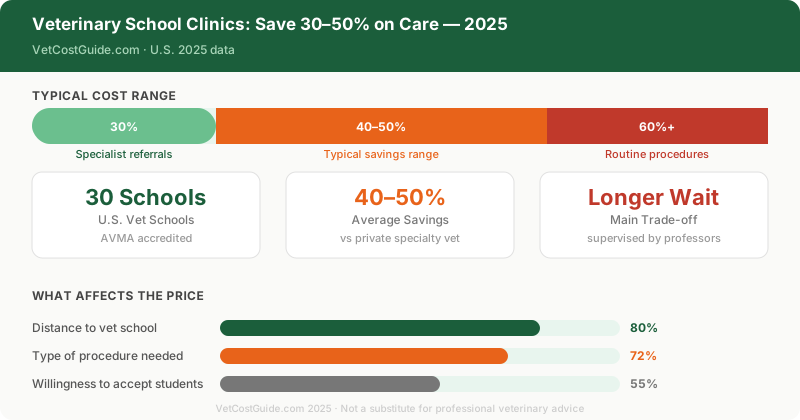
Specialty veterinary care at a private referral hospital can cost $300–500 for a consultation and $5,000–15,000 for specialist procedures. The same care at one of the 30 AVMA-accredited veterinary school teaching hospitals in the United States typically costs 30–50% less—with no reduction in the quality of clinical outcomes. These hospitals are staffed by board-certified faculty specialists, equipped with the same advanced imaging and surgical technology as the best private facilities, and open to the general public. The trade-off is time: appointments may take longer and wait times can stretch, but for non-emergency specialist needs, the cost savings are substantial and the clinical quality is exceptional.
- AVMA-accredited veterinary teaching hospitals provide specialist care—oncology, orthopedic surgery, neurology, cardiology—at 30–50% below private specialty hospital rates.
- Care is supervised by board-certified faculty veterinarians; students perform examinations and procedures under direct expert supervision.
- No income requirement applies—these hospitals are open to all pet owners, and savings are a function of the teaching model, not financial assistance.
- Wait times for appointments are typically longer than private specialty practices: plan for 2–4 week booking windows for non-emergency referrals.
Major Veterinary Teaching Hospitals and Their Services
The eight largest and most accessible teaching hospitals in the U.S. with their general contact approach and specialty strengths:
| School | Location | Specialty Strengths | Appointment Access |
|---|---|---|---|
| Cornell University | Ithaca, NY | Oncology, cardiology, internal medicine | Referral or self-referral |
| UC Davis | Davis, CA | Surgery, neurology, oncology, exotic animals | Referral preferred |
| Colorado State University | Fort Collins, CO | Oncology (Flint Animal Cancer Center), surgery | Self-referral accepted |
| Tufts University | North Grafton, MA | Cardiology, oncology, behavior | Referral required |
| University of Illinois | Urbana, IL | Surgery, internal medicine, dermatology | Self-referral accepted |
| Ohio State University | Columbus, OH | Surgery, oncology, ophthalmology | Self-referral accepted |
| Texas A&M University | College Station, TX | Surgery, internal medicine, rehabilitation | Referral preferred |
| University of Florida | Gainesville, FL | Neurology, surgery, cardiology | Referral preferred |
Cost Comparison: Teaching Hospital vs. Private Specialty
These are representative cost comparisons for commonly referred conditions. Actual costs vary by hospital, case complexity, and treatment required.
| Procedure/Service | Private Specialty Hospital | Teaching Hospital | Estimated Savings |
|---|---|---|---|
| Oncology consultation | $250–$400 | $150–$250 | 30–40% |
| Chemotherapy (per session) | $400–$800 | $250–$500 | 30–40% |
| Orthopedic surgery (TPLO) | $5,000–$7,500 | $3,000–$5,000 | 30–40% |
| MRI (brain/spine) | $2,000–$3,500 | $1,200–$2,200 | 35–40% |
| CT scan | $1,500–$2,500 | $900–$1,600 | 35–40% |
| Neurology consultation | $250–$450 | $150–$280 | 35–40% |
| Cardiology (echo + consult) | $400–$700 | $250–$450 | 35–40% |
| Ophthalmology consultation | $200–$350 | $125–$220 | 35–40% |
| Internal medicine workup | $400–$800 | $250–$500 | 35–40% |
How the Teaching Hospital Model Works
When you bring your pet to a veterinary teaching hospital, you are seen by a clinical team rather than a single veterinarian. A veterinary student or clinical resident will take the history, perform the initial examination, and develop a diagnostic and treatment plan. That plan is then reviewed, modified, and supervised by a board-certified faculty specialist who ultimately directs care.
The practical implication is that visits take longer. What takes 30 minutes at a private specialist can take 90–120 minutes at a teaching hospital as students complete their assessments and faculty review findings. For diagnostics and procedures, turnaround can also be slower. This is the primary trade-off: time for cost.
The quality of outcomes—surgical results, diagnostic accuracy, treatment effectiveness—is not meaningfully different from private specialty practice. Faculty veterinarians at these institutions are frequently among the most published and research-active specialists in their fields. The teaching environment generates rigor, not risk.
Referral vs. self-referral policies: Some hospitals require a referral from a general practice veterinarian before they will schedule a specialty appointment. Others accept self-referrals (patients who contact the hospital directly). The table above indicates general policy, but call the hospital directly—policies vary by department and may have changed.
What Affects the Savings at Teaching Hospitals
Case complexity is the largest variable. Straightforward specialist consultations and procedures generate the most predictable savings (30–50%). Highly complex cases requiring multiple specialist teams, intensive monitoring, or experimental treatments may have less predictable pricing.
Student training involvement varies by procedure. Some surgical procedures are performed entirely by residents under faculty supervision. Others involve student participation in earlier stages only. Asking about the level of student involvement for a specific procedure is appropriate.
Location relative to the hospital is a practical factor. Teaching hospitals are concentrated in university towns and cities, not evenly distributed geographically. For a pet owner in rural Iowa, driving 3 hours to Iowa State’s teaching hospital in Ames may still be more cost-effective than paying private specialty prices locally.
Pet insurance compatibility: Most major pet insurance plans cover teaching hospital care at the same reimbursement rate as private specialty care. The lower base cost at a teaching hospital means your out-of-pocket is even lower after insurance reimbursement. A $4,000 TPLO at a teaching hospital with 80% insurance reimbursement and $250 deductible costs $1,050 out-of-pocket vs. $1,550 at a private hospital charging $6,000.
- Assuming teaching hospitals have lower technology or equipment than private hospitals—most AVMA-accredited schools have MRI, CT, linear accelerator radiation therapy, and advanced surgical suites equivalent to top private facilities.
- Waiting until a non-emergency condition becomes an emergency rather than scheduling a teaching hospital appointment during the available booking window.
- Not calling to confirm whether a self-referral is accepted—calling in advance can save a rejected appointment request.
- Overlooking the emergency and critical care service at teaching hospitals, which often operates 24/7 and may be less expensive than private emergency hospitals even for acute cases.
How to Access a Veterinary Teaching Hospital
Step 1: Get a referral if needed. Ask your general practice veterinarian to refer you to the teaching hospital’s relevant department. Most GPs are supportive of this and can send records directly to the teaching hospital to expedite scheduling.
Step 2: Contact the teaching hospital’s scheduling line. Most hospitals have department-specific scheduling. Call the oncology department for cancer concerns, the surgery department for orthopedic referrals, etc.
Step 3: Request an estimate before your appointment. Teaching hospitals can provide cost estimates for consultations and planned procedures. Get this in writing so you can compare to private specialty options.
Step 4: Bring complete medical records. All prior vet notes, bloodwork, imaging studies, and medication history significantly reduce duplicate testing and speed up the clinical workup.
FAQ
Do I need a referral to be seen at a veterinary teaching hospital? It depends on the hospital and department. UC Davis, Ohio State, and University of Illinois accept many self-referrals. Cornell and Tufts typically require referrals. Call the specific department for current policy.
How far in advance do I need to book? For non-emergency specialist appointments, expect 2–4 weeks. Emergency and critical care services are available same-day or within 24 hours at most 24/7 teaching hospitals.
Will my regular vet be kept informed of the teaching hospital’s findings? Yes. Teaching hospitals routinely send detailed consultation reports to the referring veterinarian. You can also request copies of all records, imaging, and pathology results for your own files.
Can I bring an exotic pet (rabbit, bird, reptile)? Many teaching hospitals have exotic animal medicine departments. UC Davis, University of Florida, and Tufts are particularly well-regarded for exotic species. Call ahead to confirm that your specific species is seen.