Your dog just swallowed something she shouldn’t have and the ER vet is telling you she needs surgery — tonight — at a cost of $3,500. Your savings account has $800. The vet hands you a brochure for CareCredit and says you can apply on your phone right now. In moments like this, it feels like the only option. CareCredit is accepted at over 25,000 veterinary practices across the United States, and for many pet owners it genuinely is a financial lifeline. But it comes with terms that can turn a $2,000 vet bill into a $3,400 debt nightmare if you’re not careful. Here’s exactly how it works, when it makes sense, and when to look elsewhere.
- CareCredit offers 6–24 month deferred-interest promotional periods at many vet practices — pay in full before the period ends or you’re charged ALL the interest retroactively
- The standard APR is 32.99% — one of the highest in the consumer credit market
- ScratchPay is a direct competitor with true 0% plans (not deferred interest) for qualified applicants
- Always confirm your vet accepts CareCredit before applying; over 25,000 US veterinary practices are enrolled
CareCredit vs. Alternatives: Cost Comparison
| Option | $2,000 Bill | Cost to Borrow | Best For | Risk Level |
|---|---|---|---|---|
| CareCredit 12-mo promo (paid on time) | $2,000 | $0 | Disciplined payers | Low if paid in full |
| CareCredit (miss last payment) | $2,000 | $537+ retroactive interest | Nobody | High |
| ScratchPay 0% plan | $2,000 | $0 | Good credit applicants | Low |
| ScratchPay installment plan | $2,000 | $180–$340 | Fair credit | Medium |
| Scratchpay (high APR tier) | $2,000 | $400–$700 | Poor credit | High |
| Personal loan (LightStream) | $2,000 | $100–$200 | Good credit + patience | Low |
| Payment plan (vet direct) | $2,000 | Often $0 | Established clients | Very low |
How CareCredit Actually Works
CareCredit is a healthcare credit card issued by Synchrony Bank. It’s specifically designed for medical and veterinary expenses and is accepted at participating practices nationwide. Here’s the mechanics you need to understand:
Deferred Interest — The Critical Detail
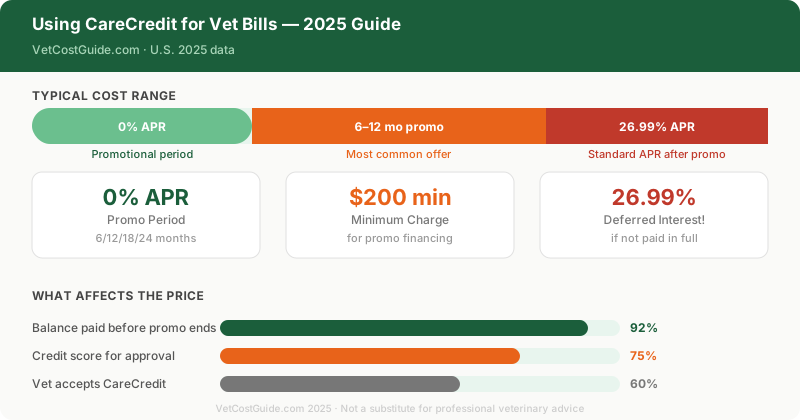
The promotional “0% financing” you see advertised is technically deferred interest, not true 0% interest. The difference is enormous. During your promotional period (typically 6, 12, 18, or 24 months), you don’t pay interest — but it accrues invisibly in the background. If you pay off the entire balance before the promotional period ends, you owe nothing extra. If you carry even $1 of balance past the deadline, Synchrony Bank charges you every penny of that accrued interest retroactively — at the full 32.99% APR, on the original balance, from day one.
On a $2,000 charge with an 18-month promo period, that retroactive interest can be $537 or more. This has caught millions of consumers off guard, and CareCredit has faced regulatory action and class-action lawsuits over the practice.
How to Apply
Applications take 5–10 minutes online at carecredit.com or via the CareCredit app. You’ll need a Social Security number, income information, and a valid address. Approval decisions are usually instant. Credit limits range from $200 to $25,000+ depending on your credit profile.
What It’s Accepted For
At veterinary practices, CareCredit can be used for wellness exams, surgery, emergency care, dental cleanings, specialist visits, medications, and boarding. Not every service at every vet is eligible — ask your practice’s front desk to confirm.
Using CareCredit Safely: Step-by-Step
Step 1: Verify your vet accepts CareCredit. Use the provider locator at carecredit.com/doctor-locator or simply call ahead. Don’t apply until you’ve confirmed acceptance.
Step 2: Apply before your appointment if possible. Having the card in hand before an emergency avoids rushed decisions. Pre-approval doesn’t cost you anything.
Step 3: Know your promotional end date — and write it down. The moment you’re approved and use the card, your promotional clock starts. Find the exact end date on your statement or in the CareCredit app. Set a calendar reminder 60 days before it expires.
Step 4: Divide the balance by the number of months and autopay that amount. Don’t pay the minimum — it’s designed to leave a balance at the end. Divide your full balance by the number of months in your promo period and set up autopay for that amount.
Step 5: Pay the remaining balance as a lump sum one month before expiration. To be safe, clear the remaining balance at least 30 days before the promo end date. Processing delays can cause last-minute payments to post late.
ScratchPay: The True 0% Alternative
ScratchPay is the primary competitor to CareCredit in veterinary financing. Key differences:
- True 0% plans (not deferred interest) are available to qualified borrowers — if you qualify, there’s genuinely no interest ever
- APRs on non-zero plans range from 0% to 29.99%, generally lower than CareCredit’s 32.99%
- Approval uses a soft credit check that doesn’t impact your credit score
- Accepted at over 10,000 veterinary practices
Apply at scratchpay.com or ask your vet if they’re enrolled. For pet owners with good to excellent credit, ScratchPay’s 0% option is often the better choice. For fair-credit applicants, compare the actual APR offered before accepting.
- Never pay just the minimum payment on CareCredit — this almost guarantees you’ll carry a balance past the promo period and owe retroactive interest
- Don’t apply for CareCredit at the vet’s front desk in a panic without understanding the deferred interest terms — take 5 minutes to read the fine print first
- Don’t ignore RedRover Relief or CareCredit’s own hardship programs if you genuinely can’t repay — these organizations can sometimes help cover or negotiate balances for qualifying situations
Real Savings and Cost Examples
Case 1 — Emily, Denver: Emily’s cat needed a $1,800 urinary surgery. She applied for CareCredit and got a 12-month promo period. She divided $1,800 by 12 = $150/month and set up autopay. She paid it off in month 11. Total cost: $1,800. Zero interest.
Case 2 — David, Houston: David used CareCredit for a $2,400 emergency vet bill on a 12-month promo. He paid minimums, thinking he was fine. With two months left, he still owed $600. When the promo expired, Synchrony charged him $792 in retroactive interest — on the original $2,400 balance at 32.99%. His total cost became $3,192.
Case 3 — Angela, Seattle: Angela’s vet accepted ScratchPay. She applied, qualified for a true 0% 12-month plan, and paid off $1,500 in vet bills with zero interest or fees. She noted it was “exactly like CareCredit but without the scary fine print.”
Frequently Asked Questions
Does applying for CareCredit hurt my credit score? Applying for CareCredit results in a hard inquiry on your credit report, which typically reduces your score by 2–5 points temporarily. If approved, the new credit line may also affect your score. For most people with established credit, the impact is minor and temporary.
Can I use CareCredit at any vet? No — CareCredit is only accepted at enrolled practices. The majority of emergency animal hospitals and most larger private practices are enrolled, but smaller or rural clinics may not be. Always confirm before applying or presenting the card.
What if I can’t pay off the balance before the promo period ends? Call Synchrony Bank (the CareCredit issuer) immediately. In some cases, they can arrange payment arrangements or hardship programs. You can also look into a balance transfer to a true 0% APR credit card to move the debt before interest kicks in. Acting early is key.
Is CareCredit available for exotic pet care? Yes — CareCredit can be used at enrolled exotic and specialty animal hospitals. Many avian, reptile, and small mammal specialty practices accept it. Search carecredit.com/doctor-locator and filter by “Veterinary” category.