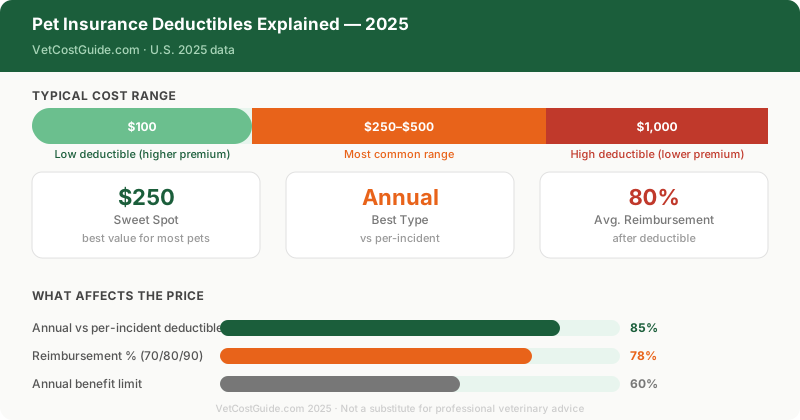
Choosing the wrong deductible structure can cost you hundreds of dollars per year—and most pet owners don’t realize there are two completely different systems until they’re staring at a claim form. Annual deductibles and per-incident deductibles work in fundamentally different ways, and the gap between them widens dramatically when your pet has more than one health issue in a single year. Understanding how each structure works before you enroll is one of the most consequential decisions you’ll make in a pet insurance policy.
- Annual deductibles are paid once per policy year regardless of how many claims you file—better for pets with multiple or recurring conditions.
- Per-incident deductibles reset every time a new condition is diagnosed, making them costly if your pet has several issues in the same year.
- A dog with both allergies and a broken leg pays $500 in per-incident deductibles vs. $250 annual—a direct $250 difference.
- Reimbursement rates of 70%, 80%, or 90% apply after your deductible is met, so the deductible structure directly determines your net out-of-pocket.
Annual vs. Per-Incident Deductible Costs Compared
The numbers below use a medium-sized dog with two separate claims in a policy year: a recurring skin allergy flare-up ($800 treatment) and a broken leg ($4,200 surgery). Deductible set at $250 for both structures.
| Scenario | Annual Deductible | Per-Incident Deductible |
|---|---|---|
| Allergy treatment ($800) | $0 (already met) | $250 |
| Broken leg surgery ($4,200) | $0 (already met) | $250 |
| Total deductible paid | $250 | $500 |
| Reimbursable at 80% | $3,800 | $3,500 |
| Net out-of-pocket (total $5,000 bills) | $950 | $1,250 |
The annual deductible saves this hypothetical dog owner $300 in a single year. With a chronic condition like allergies recurring year after year, the savings compound significantly.
How Each Deductible Structure Works
Annual deductible works exactly like a human health insurance deductible. You pay the set amount—typically $100, $250, or $500—once per policy year, and then every covered claim for the rest of that year is reimbursed at your chosen rate (70%, 80%, or 90%) without any additional deductible. If your dog needs three separate vet visits for three separate issues in October, November, and December, you’ve only paid the deductible once.
Per-incident deductible (also called per-condition) applies separately to each distinct medical condition. Trupanion is the most prominent insurer using this model. The logic is that you pay a deductible each time a new diagnosis is made. The potential upside: for a pet with a single large incident, the per-incident total might equal the annual total. The downside becomes clear the moment a second unrelated condition appears—you pay the deductible again from scratch.
Some per-incident plans also carry the deductible forward for the same ongoing condition. Under Trupanion’s structure, once you’ve paid the per-incident deductible for, say, diabetes, that same condition is covered without an additional deductible in future years. This nuance partially offsets the disadvantage for long-term chronic conditions—but only for that specific condition.
What Affects How Much Your Deductible Costs You
Number of conditions per year is the single biggest factor. One incident per year? Per-incident and annual deductibles produce identical out-of-pocket costs. Two or more incidents? Annual wins every time.
Condition type matters significantly. Ongoing allergies, diabetes, epilepsy, and IBD are repeat-visit conditions that benefit from the annual structure. A one-time traumatic injury—hit by car, swallowed a foreign object—is roughly neutral between the two structures.
Deductible amount selection multiplies the impact. Annual deductibles range from $100 to $500 on most plans. Per-incident deductibles on Trupanion start at $200 and go up to $1,000. A $500 per-incident deductible on a three-claim year means $1,500 paid before a cent is reimbursed.
Reimbursement rate interacts with the deductible directly. Here’s how $5,000 in total vet bills plays out across the main combinations:
| Deductible | Reimbursement Rate | Your Net Cost (on $5,000 bills) |
|---|---|---|
| $100 annual | 90% | $590 |
| $250 annual | 80% | $1,150 |
| $500 annual | 70% | $2,150 |
| $250 per-incident (2 claims) | 80% | $1,400 |
| $500 per-incident (2 claims) | 80% | $1,900 |
Breed and age affect the probability of multiple claims per year. French Bulldogs average 2.4 insurance claims per year according to NAPHIA data. Golden Retrievers have elevated cancer rates after age 8. German Shepherds are prone to degenerative myelopathy alongside orthopedic issues. If your dog’s breed predisposes them to multiple concurrent conditions, the annual deductible structure is almost always the better financial choice.
Premium differences also factor in. Plans with annual deductibles may carry slightly higher monthly premiums than per-incident plans at the same reimbursement rate. Run the full 12-month math: premium × 12 + likely deductible costs vs. an alternative structure.
- Choosing per-incident because the monthly premium is $5-10 cheaper without calculating how multiple claims change the math.
- Not confirming whether a recurring condition resets the deductible each year or only once—this varies significantly by insurer.
- Selecting a $500 deductible to lower premiums on a senior dog who makes 3+ vet visits per year.
- Assuming “per-incident” and “per-condition” mean the same thing across all insurers—definitions differ.
How to Choose and Get Started
Choose annual deductible if: Your pet already has a diagnosed recurring condition, your breed is prone to multiple health issues, or your pet is over age 6.
Choose per-incident if: You have a young, generally healthy pet and are primarily insuring against one catastrophic event, or you’re enrolling with Trupanion specifically, where the lifetime per-condition structure limits deductible exposure.
The practical steps: get quotes from at least three insurers using the same reimbursement rate (80%) and deductible amount ($250) so you’re comparing apples to apples. Embrace, ASPCA, Spot, and Lemonade all use annual deductibles. Trupanion uses per-incident. Figo and Pets Best offer both structures on select plans.
Enroll before your pet’s first vet visit for any new condition—pre-existing exclusions apply from the moment of diagnosis, not from the time you enroll.
FAQ
Can I change my deductible structure after enrollment? Most insurers lock in the deductible structure at enrollment and don’t allow mid-policy changes. You can typically change the amount (e.g., from $250 to $500) at renewal.
Does the deductible reset every year with annual plans? Yes. Annual deductibles reset at each policy renewal date—usually the 12-month anniversary of your enrollment.
What’s the most common deductible amount pet owners choose? $250 annual is the most popular choice according to NAPHIA’s 2024 industry report, balancing premium savings against manageable out-of-pocket exposure.
Is there a deductible-free pet insurance option? A few wellness-only add-ons have no deductible for routine care, but comprehensive accident and illness plans universally require one. Trupanion offers a $0 per-incident deductible option at a significantly higher premium.