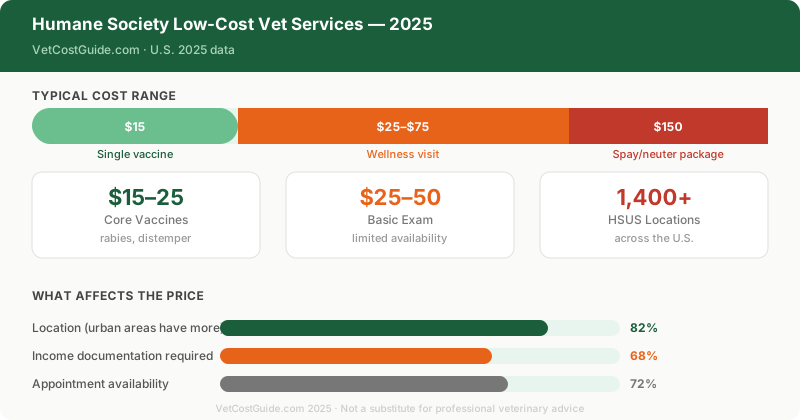
The term “Humane Society clinic” covers a lot of ground, and understanding exactly what services are available before you drive across town is essential. In the U.S., there is no single national Humane Society veterinary network—the Humane Society of the United States (HSUS) is a policy advocacy organization, not a clinic operator. The low-cost clinics most people associate with the name are operated independently by local Humane Societies, SPCAs, and community animal welfare organizations that may or may not have any affiliation with national groups. What’s on offer varies widely by location, but the core services—vaccines, spay/neuter, microchipping—are consistently available at dramatically below-market rates.
- Low-cost Humane Society-affiliated clinics offer core vaccines for $15–25 each, wellness exams for $25–50, and spay/neuter for $50–150—typically 50–70% below private practice rates.
- These clinics are almost universally focused on preventive care and basic wellness; emergency care, specialist referrals, and complex diagnostics are generally not available.
- Income verification is sometimes required but not universal—many clinics are open to any pet owner regardless of income.
- ASPCA’s free online database and the HSUS “Find a Low-Cost Vet” tool are the two most reliable ways to locate a clinic near you.
What Low-Cost Clinics Typically Charge
Prices reflect typical ranges across HSUS-affiliated and ASPCA-partnered low-cost clinics in 2025. Costs vary by region—urban areas on the coasts may be at the higher end of these ranges; rural Midwest and South often at the lower end.
| Service | Low-Cost Clinic Price | Private Practice Price | Typical Savings |
|---|---|---|---|
| Wellness exam | $25–$50 | $55–$85 | 50–55% |
| Rabies vaccine | $15–$20 | $25–$35 | 40–50% |
| DHPP vaccine (dogs) | $15–$25 | $25–$40 | 40–50% |
| FVRCP vaccine (cats) | $15–$22 | $22–$38 | 40–50% |
| Bordetella vaccine | $15–$20 | $20–$35 | 40–50% |
| Microchipping | $15–$25 | $35–$55 | 50–60% |
| Flea/tick treatment (topical) | $15–$30 | $25–$55 | 35–50% |
| Heartworm test | $25–$40 | $45–$75 | 40–50% |
| Spay (dog, under 50 lbs) | $75–$150 | $200–$500 | 50–70% |
| Spay (cat) | $50–$100 | $150–$300 | 50–65% |
| Neuter (dog) | $60–$120 | $150–$400 | 50–70% |
| Neuter (cat) | $40–$75 | $100–$200 | 55–65% |
Services Typically Offered and Not Offered
What low-cost clinics generally provide:
Core preventive services are the backbone of these clinics—vaccines, microchipping, flea/tick/heartworm prevention, and basic wellness exams. Spay/neuter is universally available and is often the primary mission of the organization. Some clinics offer basic dental cleaning (scaling without extractions) and nail trims.
A growing number of community clinics are expanding into basic sick-pet services: treatment for ear infections, skin issues, minor wounds, and intestinal parasites. Prescription medication dispensing for straightforward conditions is increasingly common.
What low-cost clinics generally do NOT provide:
Emergency care is almost universally outside the scope of these clinics. They are not equipped for after-hours emergencies, critical care, or intensive monitoring. If your pet needs urgent stabilization, a private emergency hospital is the appropriate resource.
Specialist referral care—oncology, neurology, orthopedic surgery, cardiology—is not available. Complex diagnostics like CT scans, MRIs, endoscopy, and advanced echocardiography require specialist-equipped facilities.
Complex surgery beyond routine spay/neuter is generally outside scope, though some higher-funded clinics will perform simple mass removals or foreign body extractions. Call before assuming.
In-house bloodwork panels are available at some but not all low-cost clinics. Basic CBC and chemistry panels may be offered; advanced diagnostics typically are not.
Finding a Clinic Near You
ASPCA’s database at aspca.org/pet-care/general-pet-care/low-cost-veterinary-care is the most comprehensive free resource. Enter your ZIP code and filter by service type. The database includes both ASPCA-operated clinics and partner organizations.
HSUS resource page at humanesociety.org/resources/find-low-cost-vet-care lists national and regional programs with links to individual organization websites.
SpayUSA (spayusa.org) specifically locates low-cost spay/neuter clinics nationwide—useful if sterilization is your primary need.
Local search approach: Search “[your city] low cost vet clinic” or “[your county] humane society clinic.” Many excellent clinics aren’t indexed in national databases. Your local animal shelter’s front desk staff will typically know every low-cost resource in a 20-mile radius.
What to Expect at a Low-Cost Clinic Visit
Appointment availability varies significantly. High-demand urban clinics may book 3–6 weeks out for elective services like wellness exams and vaccines. Some clinics operate on a first-come, first-served walk-in basis. Call ahead to understand the scheduling model.
Wait times at walk-in clinics can be substantial—plan for 1–3 hours in busy locations. Bring water, keep your pet in a carrier or on a leash, and confirm what documentation to bring (proof of rabies vaccine history, prior medical records if relevant).
Clinical environment is typically basic but adequate for the services offered. You won’t find digital x-ray suites or advanced monitoring equipment, but vaccine administration and wellness exams don’t require them.
Income verification: Some clinics require proof of income (pay stubs, benefits cards) to qualify for reduced rates. Others are open to all pet owners regardless of income and use a flat low-cost fee structure. Call ahead to understand the specific clinic’s requirements.
- Arriving at a low-cost clinic expecting emergency or urgent care—these facilities are not equipped for acute illness or injury and will refer you elsewhere.
- Assuming all “Humane Society” clinics are the same—each independent organization sets its own service list, prices, and income requirements.
- Not calling ahead about appointment availability—walk-in clinics can have hours-long waits; appointment-based clinics may be booked weeks out.
- Skipping vaccines because a low-cost clinic appointment isn’t convenient—the $15–25 vaccine cost at a community clinic is always cheaper than treating the preventable disease.
How to Maximize Value from Low-Cost Clinic Services
Combine services in a single visit when possible. A wellness exam, annual vaccines, and heartworm test in one appointment maximizes the value of a single trip. Some clinics offer bundled wellness packages that include multiple services at an additional discount.
Use low-cost clinics for preventive and routine care, and maintain a relationship with a private practice for any sick-pet care, complex diagnostics, or specialty needs. This hybrid model provides the best cost-to-quality balance for most pet owners.
If income verification is required at your local clinic and you don’t qualify for the lowest tier, ask whether there’s a mid-tier sliding scale or whether any services can be provided at standard low-cost rates regardless of income.
FAQ
Is the care at low-cost clinics lower quality than private practices? The vaccinations and basic wellness care are identical in clinical quality—the same vaccines, administered by licensed veterinary technicians or veterinarians. The difference is scope of services and resources available, not care quality for the services they do provide.
Can I take a dog with an unknown vaccination history to a low-cost clinic? Yes. Clinics are accustomed to new adoptees, strays, and pets with incomplete records. They will administer vaccines based on current needs regardless of prior history.
Do low-cost clinics offer heartworm treatment, not just testing? Generally no. Heartworm treatment (melarsomine injections) requires monitoring, strict rest protocols, and follow-up care beyond the scope of most low-cost clinics. They will diagnose heartworm disease and refer you to a private practice for treatment.
Is microchipping at a low-cost clinic the same chip as a private practice? Yes. Standard ISO microchips ($15–25 at low-cost clinics vs. $35–55 at private practices) are identical regardless of where they’re implanted. Make sure to register the chip number with a national registry like HomeAgain or Found Animals—the chip is useless without registration.