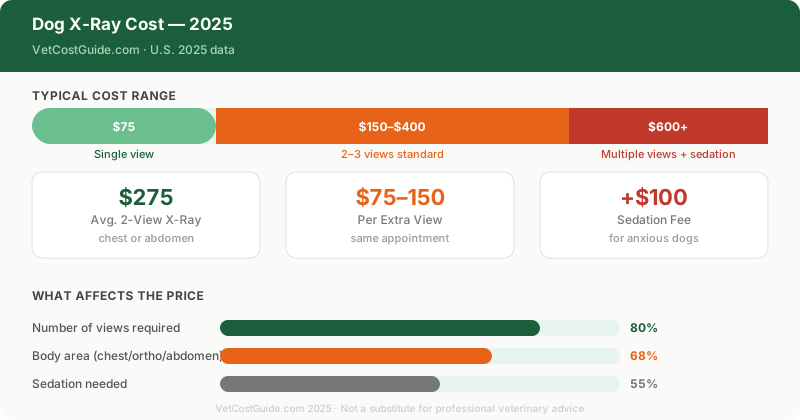
When your dog limps in after a rough landing at the dog park, or swallows something that may or may not have been a sock, your vet’s first imaging tool is almost always an X-ray. At $75 to $400 for most cases, radiographs are the most accessible diagnostic imaging option in veterinary medicine — but the number of views ordered matters enormously for both cost and accuracy. A single view misses things that a two-view series catches every time.
- A single X-ray view costs $75–$150 at most general practices in 2025.
- A two- or three-view series (standard for chest, abdomen, or joint evaluation) runs $150–$400.
- Sedation or anesthesia adds $75–$250 and is often needed for accurate limb or spine films.
- A radiologist consultation (remote read) adds $50–$120 on top of the imaging fee.
- Emergency X-rays at 24-hour hospitals typically cost 40–60% more than daytime general practice rates.
What Does a Dog X-Ray Cost?
Costs vary by body region, number of views, facility type, and whether sedation is required. The table below reflects 2025 national averages at general practice clinics.
| X-Ray Type | Low | Average | High |
|---|---|---|---|
| Single view (any region) | $75 | $120 | $175 |
| Two-view series (limb/joint) | $110 | $175 | $250 |
| Chest series (2–3 views) | $130 | $200 | $310 |
| Abdominal series (2 views) | $120 | $190 | $290 |
| Spine series (per region) | $130 | $210 | $320 |
| Dental X-rays (full mouth) | $100 | $175 | $280 |
| Sedation/anesthesia add-on | $75 | $160 | $280 |
| Radiologist remote read | $50 | $85 | $125 |
What the Procedure Involves
A veterinary radiograph uses the same ionizing radiation principle as human X-rays. Your dog is positioned on a padded table and held still — by a trained technician or, for cooperative dogs, with gentle manual restraint — while the X-ray beam passes through the body and creates an image on a digital detector.
Digital radiography (DR) has replaced film in nearly all modern practices. Images appear in seconds on a workstation, can be zoomed and adjusted for contrast, and are emailed to specialist radiologists for remote reads within hours. The equipment costs $30,000–$80,000 for a practice, which is reflected in imaging fees.
Number of views: This is the detail most pet owners miss. A single lateral (side-view) film of the chest shows gross abnormalities but misses early fluid accumulation, small masses behind the heart, and subtle rib lesions. The standard chest series is three views — right lateral, left lateral, and ventrodorsal — because each position shifts the organs and reveals different information. Skimping on views to save $40–$80 is a false economy when the information changes the diagnosis.
Positioning for accuracy: Orthopedic films (elbows, hips, stifles) require precise positioning that a stressed or painful dog resists. Even a few degrees of rotation makes joint space measurements inaccurate. This is why sedation or light anesthesia is frequently recommended for limb films — the images are more diagnostically useful and the dog is more comfortable.
What Factors Affect the Cost?
Number of views ordered. Each additional view is typically billed at a per-view rate of $40–$90. A radiologist or experienced clinician knows that certain regions require multiple angles — one view is standard practice only for straightforward foreign body screening.
Body region. Dental X-rays require specialized intraoral sensors and typically involve 10–16 individual images per full-mouth series. Spinal films covering cervical, thoracic, and lumbar regions are billed per region. Hip X-rays for OFA (Orthopedic Foundation for Animals) certification require specific extended-leg positioning under sedation and include a reading fee from OFA ($35 add-on).
Sedation requirements. Painful, fearful, or fractious dogs need sedation for safe, accurate positioning. The cost of sedation ($75–$250) often more than doubles the imaging bill but delivers diagnostic-quality images rather than blurry, repositioned attempts.
Radiologist interpretation. General practitioners interpret their own X-rays at no extra charge. For complex cases — suspected lung tumors, spinal cord compression, subtle fractures — sending images to a board-certified veterinary radiologist via telemedicine services (VetRad, Idexx Telemedicine) adds $50–$120 but significantly improves diagnostic accuracy.
Geographic region and facility type. Emergency hospitals and specialty centers charge 40–80% more than daytime general practice rates. Urban clinics in coastal cities run 20–35% above the national average.
- One view is rarely enough for the chest or abdomen. A single lateral film may look normal while a ventrodorsal view reveals a mass or fluid pocket. If your vet recommends a full series, the extra views are clinically justified.
- Foreign body X-rays have limits. Radiolucent objects (fabric, rubber, some plastics) don’t show up on standard X-rays. If your dog swallowed something and the film looks clear, an ultrasound or contrast study may still be needed.
- Repeat films add up fast. A poorly positioned film that misses the pathology leads to a repeat exposure and a second billing cycle. Paying for sedation upfront is often cheaper than two sessions of diagnostic-quality X-rays.
When Is It Necessary vs. Optional?
Necessary: Suspected fractures or dislocations after trauma. Respiratory distress or abnormal lung sounds. Abdominal distension or suspected bloat (GDV). Suspected foreign body ingestion. Pre-surgical orthopedic planning. Any dog showing spinal pain or neurological deficits.
Strongly recommended: Coughing dogs over age 7 (lung tumor screening). Dogs with heart murmurs (chest film to assess cardiac size). Breed-specific screening — hip dysplasia X-rays for large breeds at age 2. Limping dogs with localized pain on exam.
Optional: Routine wellness imaging without clinical signs is generally not recommended and not covered by most wellness plans. Some boarding facilities require health certificates that include a chest film — this is standard for traveling internationally.
How to Reduce the Cost
Ask your vet what’s diagnostically required. If your dog has a straightforward limb injury and clinical exam strongly suggests a soft tissue sprain, your vet may agree that a single view is adequate for the initial visit. Escalate to a full series if the single view is inconclusive.
Request in-house interpretation first. Remote radiologist reads add $50–$120 but may not be needed for straightforward cases. Ask your vet if they’re comfortable interpreting the films themselves, with the option to consult a radiologist if findings are ambiguous.
Use a general practice for non-urgent films. Scheduling daytime appointments with your regular vet for non-emergency imaging avoids the emergency surcharge. If your dog’s condition is stable and it’s 9 p.m., waiting until morning can save $100–$200.
Check for wellness plan inclusions. Some annual wellness plans include one free set of radiographs per year. Ask your practice before ordering.
Frequently Asked Questions
Are dog X-rays dangerous? The radiation dose from a standard two-view series is extremely low — comparable to a few hours of natural background radiation. Veterinary teams step behind a shield during exposures as a routine occupational precaution, not because the dose to your dog is hazardous.
Will my dog be sedated for X-rays? Not always. Cooperative, pain-free dogs can be positioned manually for many views. Sedation is recommended when the dog is painful, fractious, or when precise positioning is essential for diagnosis — particularly for orthopedic and spinal studies.
Can I get X-ray images sent to a specialist? Yes. Digital X-ray files (DICOM format) can be emailed or uploaded to a sharing portal. Most practices will send images to a specialist referral or to an online radiologist at your request. Always ask for a copy for your own records.
What’s the difference between an X-ray and a CT scan for dogs? X-rays are two-dimensional projections that are fast, affordable, and excellent for dense structures like bone and the air-filled chest. CT scans produce three-dimensional cross-sectional images at much higher resolution and detail, but cost $800–$2,500 and require general anesthesia. Your vet will recommend CT when X-ray findings are inconclusive or when surgical planning requires precise anatomical mapping.