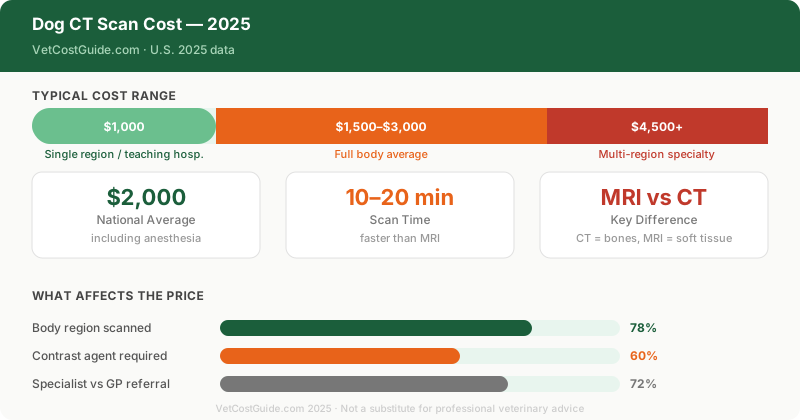
When your vet says your dog needs advanced imaging, the next question is almost always: CT or MRI — and what does each cost? In 2025, a dog CT scan runs $1,000–$3,500 depending on the region scanned and where you go, while MRI costs $1,500–$4,000. Both require general anesthesia, and both produce information that standard X-rays simply cannot. Understanding which modality is right for your dog’s specific condition helps you ask the right questions and avoid paying for the wrong test.
- A dog CT scan for a single body region costs $1,000–$2,000; a full-body CT runs $2,000–$3,500.
- Dog MRI costs $1,500–$4,000 depending on the region and facility — it takes longer and costs more, but produces superior soft tissue detail.
- Teaching hospitals cost 25–35% less than private specialty imaging centers for both modalities.
- Both CT and MRI require general anesthesia, which adds $200–$400 to the total cost and requires pre-anesthetic bloodwork.
What Does a Dog CT Scan or MRI Cost?
Pricing varies by region scanned (more regions = higher cost), facility type, and geographic location. These 2025 figures reflect US national averages across urban and suburban specialty centers.
| Imaging Type | Low | Average | High |
|---|---|---|---|
| CT scan – single region (head, chest, or abdomen) | $1,000 | $1,500 | $2,000 |
| CT scan – two regions | $1,500 | $2,200 | $3,000 |
| CT scan – full body | $2,000 | $2,800 | $3,500 |
| MRI – single region | $1,500 | $2,500 | $4,000 |
| MRI – brain or spine (most common) | $1,800 | $2,800 | $4,000 |
| Pre-anesthetic bloodwork | $80 | $150 | $220 |
| Anesthesia and monitoring (included in most packages) | $200 | $300 | $400 |
| Teaching hospital discount (approx.) | –25% | –30% | –35% |
What’s Included
Both CT and MRI fees at a specialty center typically include the imaging procedure, anesthesia induction and monitoring, a radiologist’s interpretation report, and a consultation with the specialist about findings. Pre-anesthetic bloodwork is usually billed separately by the referring vet or the specialty hospital and is not optional — it confirms the kidneys and liver can safely process anesthetic drugs.
At teaching hospitals, the package often includes a longer appointment with a faculty radiologist review, which is one reason the wait time may be slightly longer. Private imaging centers offer faster scheduling and sometimes same-day or next-day availability, at a premium.
Most facilities send imaging data to a board-certified veterinary radiologist (DACVR) for interpretation. If the imaging was performed at a general practice with in-house CT equipment, add $100–$200 for specialist radiologist interpretation if it is not included.
What Affects the Cost
Number of regions scanned. Imaging the chest alone versus a chest-plus-abdomen CT roughly doubles the time under anesthesia and the diagnostic scope of the study. Nasal tumor staging, for example, often requires imaging both the nasal cavity and the chest (to check for pulmonary metastasis) — two separate regions at full cost each.
CT vs. MRI — the right test for the right question. CT uses X-ray beams processed into cross-sectional images and excels at high-contrast structures: bone, calcification, lung tissue, vascular anatomy, and solid abdominal organs. MRI uses magnetic fields and radio waves, producing superior resolution of soft tissues: the brain, spinal cord, intervertebral discs, ligaments, tendons, and nasal soft tissue. Ordering the wrong modality produces inferior information and may require repeating the test at additional cost and anesthetic risk.
CT is the right choice for: nasal tumors and sinus disease, chest and lung evaluation, bone fracture assessment and surgical planning, abdominal organ masses, and thoracic staging of cancer.
MRI is the right choice for: brain lesions, seizure workup, spinal cord compression and IVDD (intervertebral disc disease), inner ear disease, and soft tissue masses adjacent to neural structures.
Anesthesia. Dogs cannot remain perfectly still in a CT or MRI scanner the way cooperative human patients can. General anesthesia is required for both modalities. The anesthetic risk is low in healthy patients but increases meaningfully in brachycephalic breeds (Bulldogs, Pugs, French Bulldogs), elderly dogs, and dogs with cardiac or respiratory disease. Pre-anesthetic workup and monitoring add cost but are not negotiable.
Geographic location. Specialty imaging in New York, Los Angeles, and Boston typically costs 25–40% more than the same procedure in Phoenix, Kansas City, or Raleigh. If you are near multiple specialty facilities, price comparison is straightforward — call and ask for the all-inclusive estimate including anesthesia.
Contrast agent. Both CT and MRI can be performed with or without intravenous contrast (a dye that enhances blood vessel and tumor visualization). Contrast studies add $80–$150 to the base cost but are often recommended for tumor staging and vascular evaluations.
- Getting a CT when your dog needs an MRI for a spinal problem. CT can detect bone involvement in spinal disease but frequently misses soft tissue disc herniations that MRI would clearly show. If your dog is having neurological signs — dragging a leg, sudden paralysis, severe neck pain — push for MRI guidance from a neurologist rather than accepting CT as a cheaper substitute.
- Facilities that don’t include radiologist interpretation. Some general practices with in-house CT equipment do not include board-certified radiologist review in their quoted price. Ask explicitly whether a DACVR interprets the images, and budget for that fee separately if not included.
- Skipping pre-anesthetic bloodwork. Especially in dogs over seven years old, pre-anesthetic bloodwork is an important safety screen. Declining it to save $80–$150 is not a sensible trade-off given the anesthetic risk of a 30–60 minute procedure.
Is Pet Insurance Worth It?
Advanced imaging is covered under the diagnostic category of most comprehensive pet insurance policies. With a $500 deductible and 80% reimbursement, a $2,500 CT scan returns $1,600 to the owner. Because CT and MRI are typically ordered as part of workup for serious conditions — cancer, neurological disease, orthopedic injury — they frequently appear alongside surgical claims on the same invoice, magnifying the total reimbursement.
One nuance: imaging ordered to investigate a condition that was present or suspected before your policy start date may be excluded as a pre-existing condition diagnostic. Enroll while your dog is young and healthy, before any presenting symptoms generate medical records.
How to Save Money
Ask your specialist which modality is genuinely required. CT is faster (15–30 minutes under anesthesia vs. 45–90 for MRI), less expensive, and fully adequate for many conditions. If your neurologist says MRI is necessary for your dog’s spinal problem, trust that — but if the question is about a chest mass or a bone lesion, confirm that CT is the right tool before defaulting to the more expensive option.
Request a teaching hospital referral. Veterinary schools with radiology residency programs — UC Davis, Cornell, Colorado State, Ohio State, University of Florida, and others — charge 25–35% less than private imaging centers for the same studies with equivalent radiologist oversight. Your primary vet can make the referral.
Bundle imaging with a specialist consultation. If you are already being seen at a specialty hospital for neurology, oncology, or surgery, imaging performed during the same visit at that facility is often discounted compared to a standalone imaging appointment. Ask about bundled pricing.
Get the full estimate including anesthesia. Some facilities quote the imaging fee and bill anesthesia separately. Request a complete all-in estimate: imaging, anesthesia, contrast agent if applicable, and interpretation. This prevents billing surprises at discharge.
Use CareCredit for same-day financing. Most specialty imaging centers accept CareCredit. A $2,500 imaging bill financed at 0% APR for 12 months costs $208 per month. Apply before your appointment if you anticipate needing it.
Frequently Asked Questions
How long does a dog CT scan take? The imaging itself typically takes 15–30 minutes. Total time at the facility, including anesthesia induction, recovery, and discharge consultation, runs two to four hours. MRI takes longer — 45–90 minutes of imaging — making total facility time three to five hours for most patients.
Is anesthesia for CT or MRI dangerous for my dog? Modern veterinary anesthesia in healthy patients carries very low risk — roughly 1 in 1,000–2,000 for complications in ASA I–II (healthy) patients. The risk increases for brachycephalic breeds, elderly dogs, and dogs with concurrent disease. Your anesthetist will assess your dog’s risk category and discuss it with you during the pre-procedure consultation.
My vet ordered a CT scan but I read that MRI is better. Should I push back? Discuss the reasoning with your vet or specialist. The right answer depends entirely on what they are looking for. CT is better for bones, lungs, and abdominal organs; MRI is better for the brain, spinal cord, and soft tissue masses. If you are unsure, ask the specialist to explain why they chose the specific modality for your dog’s condition — a good clinician will be happy to explain the reasoning.
Can the CT or MRI be done without anesthesia if my dog is calm? No, not reliably. Even the calmest dog will shift, breathe heavily, or swallow during a scan — any of which degrades image quality enough to make the study non-diagnostic. Attempting to image a dog without anesthesia almost always results in a repeat study under anesthesia, doubling the cost and the anesthetic exposure. Anesthesia is standard of care for both modalities.