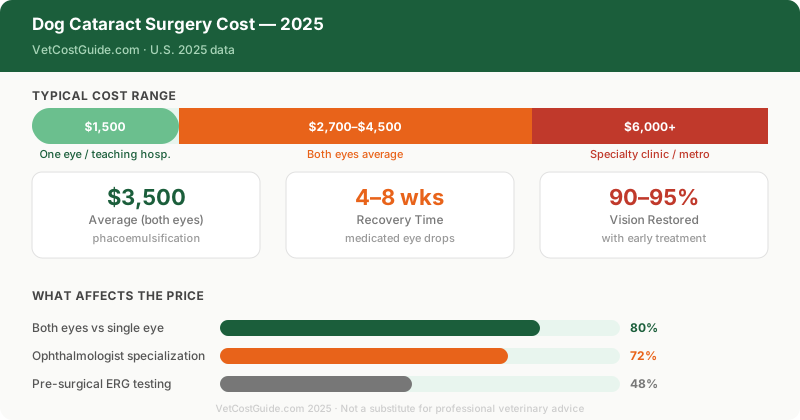
When your dog’s eyes go cloudy and your vet refers you to a veterinary ophthalmologist, the price tag that comes back can be genuinely shocking. Cataract surgery in dogs runs $1,500–$6,000 per eye depending on where you go and what diagnostic work is needed — and because this is a specialty procedure performed by a board-certified veterinary ophthalmologist, there is no cheaper general-practice version. Understanding what drives that cost before you sit in the exam room puts you in a much better position to plan.
- Single-eye surgery at a teaching hospital costs $1,500–$2,500; a private specialty clinic runs $4,000–$6,000 per eye.
- Both eyes averaged together typically cost $3,000–$5,000 total at a teaching hospital or $7,000–$10,000 at a private practice.
- Pre-surgical testing — ophthalmology exam and an electroretinogram (ERG) — adds $500–$900 before any cutting begins.
- Post-operative eye drops typically run $60–$120 per month for three months, adding $180–$360 per eye to the total cost.
What Does Dog Cataract Surgery Cost?
The procedure itself — phacoemulsification, the same ultrasonic technique used in human cataract surgery — is the largest line item, but pre-surgical diagnostics and post-op medications contribute meaningfully to total out-of-pocket costs.
| Service | Low | Average | High |
|---|---|---|---|
| Ophthalmologist exam (pre-surgical) | $200 | $300 | $400 |
| Electroretinogram (ERG test) | $300 | $400 | $500 |
| Cataract surgery – single eye (teaching hospital) | $1,500 | $1,900 | $2,500 |
| Cataract surgery – single eye (private specialty clinic) | $3,000 | $4,000 | $6,000 |
| Cataract surgery – both eyes (teaching hospital) | $2,500 | $3,500 | $4,500 |
| Cataract surgery – both eyes (private specialty clinic) | $5,500 | $7,500 | $10,000 |
| Post-op eye drops (per eye, 3 months) | $180 | $250 | $360 |
| Post-op recheck exams (2–3 visits) | $150 | $250 | $400 |
What’s Included
Cataract surgery in dogs follows the same basic steps as the human version. The ophthalmologist uses a small ultrasonic probe to break up the cloudy lens — a technique called phacoemulsification — then vacuums out the fragments and places an artificial intraocular lens (IOL) implant in its place. The implant is included in the surgical fee.
Your total package typically covers: the surgical procedure itself, the IOL implant, anesthesia and anesthetic monitoring, intraoperative retropulsion testing to check the implant position, and a first post-operative exam. Most practices also include one or two early recheck visits in the surgical fee; others charge separately.
What is almost always separate: the pre-surgical ophthalmologist consultation ($200–$400), the electroretinogram test ($300–$500), take-home eye drops (multiple formulations are typically dispensed), and any follow-up visits beyond the first month.
What Affects the Cost
Bilateral vs. single eye. Most dogs with cataracts develop them in both eyes, and ophthalmologists strongly recommend operating on both when possible to maximize long-term vision outcomes. Operating on both eyes in the same anesthetic session adds cost but is more economical than two separate procedures — you pay for anesthesia only once.
Specialist required. There is no general-practice version of this surgery. Cataract phacoemulsification in dogs requires a board-certified veterinary ophthalmologist (DACVO) and specialty microsurgical equipment. This is a fixed cost factor that cannot be worked around.
The ERG test is non-negotiable. Before surgery, the ophthalmologist must confirm that the retina behind the cataract is still functional. An electroretinogram (ERG) measures electrical activity in the retinal cells. If the retina has deteriorated (as happens in progressive retinal atrophy), surgery will restore no vision. At $300–$500, the ERG prevents a $3,000–$6,000 surgery from being performed on a dog who cannot benefit from it.
Geographic location. Specialty ophthalmology practices in major metro areas — New York, Los Angeles, Chicago, Seattle — charge 20–40% more than practices in smaller cities or Midwestern states.
Post-op compliance. Dogs require multiple eye drops per day for several weeks after surgery, tapering over three months. Non-compliance significantly increases the risk of complications like glaucoma or lens capsule opacification, both of which may require additional intervention and cost.
- Delaying surgery too long. Mature and hypermature cataracts are harder to remove and carry higher complication rates than immature ones. If your vet identifies a developing cataract, consult an ophthalmologist early — do not wait until vision is fully gone.
- Skipping the ERG. A practice that offers to skip the electroretinogram to reduce pre-surgical costs is not doing you or your dog a favor. The ERG is the essential gatekeeping test that prevents futile surgery. Do not accept a shortcut here.
- Underestimating post-op costs. Eye drops, recheck exams, and potential complication management in the three to six months after surgery can add $500–$1,000 to the total. Build this into your budget before approving the procedure.
Is Pet Insurance Worth It?
Cataract surgery is one of the highest single-claim procedures in veterinary ophthalmology, making this exactly the scenario pet insurance is designed for. With a $500 deductible and 80% reimbursement on a $7,000 bilateral surgery, you’d receive approximately $5,200 back. The critical caveat: cataracts in dogs are often hereditary (Labrador Retrievers, Golden Retrievers, Poodles, Cocker Spaniels, Boston Terriers, and Bichon Frises are high-risk breeds). Many insurers classify hereditary cataracts as a breed-specific exclusion, particularly if there is any prior documentation of lens changes before the policy start date.
Enroll your dog in a comprehensive policy before any eye symptoms are noted, and specifically ask about hereditary condition coverage. If your dog is already showing lens cloudiness, some policies will exclude the condition as pre-existing. Still, even a policy that covers only one eye at 80% can return $2,000–$4,000 on a single claim.
How to Save Money
Request a teaching hospital referral. Veterinary schools with ophthalmology residency programs — Colorado State, Cornell, UC Davis, University of Wisconsin, and others — perform cataract surgery at 25–40% lower cost than private specialty clinics. The resident is supervised by a DACVO faculty member; outcomes are comparable.
Combine both eyes in one anesthetic event. If both eyes need surgery, doing them simultaneously saves the cost of a second anesthesia induction, monitoring, and surgical setup. This typically reduces the two-eye total by $800–$1,500 compared to two separate procedures.
Ask about the IOL upcharge. Most ophthalmologists include a standard IOL in the surgery price. Premium implant lenses are sometimes offered at additional cost. The standard lens produces good functional vision in nearly all dogs; the upgrade is rarely medically necessary.
Price medications in advance. Post-op eye drops are often available through compounding pharmacies or human pharmacies at lower cost than the practice dispensary. Ask your ophthalmologist whether the specific formulations prescribed are available outside the clinic before assuming you must buy them on-site.
Use CareCredit or Scratchpay. Most veterinary specialty clinics accept third-party veterinary financing. A 0% APR promotion period of 12–18 months makes a $6,000–$8,000 total bill manageable at $400–$650 per month without interest charges.
Frequently Asked Questions
Can cataracts in dogs be treated with eye drops instead of surgery? No. Eye drops marketed as cataract treatments for dogs have no peer-reviewed evidence of efficacy. Cataracts are a physical cloudiness of the lens proteins and cannot be reversed with medication. Surgery is the only treatment that restores vision.
What happens if I don’t do the surgery? Cataracts that are left untreated can progress to lens-induced uveitis (painful intraocular inflammation), glaucoma, and in severe cases lens luxation. Many dogs with untreated mature cataracts develop secondary glaucoma that is more expensive and painful to manage than the original surgery would have been. Even if you decline surgery, regular ophthalmology monitoring is recommended.
How long does recovery take? Most dogs return to normal activity within two to four weeks. The first two weeks require strict Elizabethan collar use and multiple daily eye drop applications. Full resolution of post-surgical inflammation takes six to eight weeks. Long-term vision outcomes are excellent: roughly 85–90% of dogs that pass pre-surgical testing regain functional vision after phacoemulsification.
Does my dog need to be a certain age to have cataract surgery? There is no strict age cutoff, but the ophthalmologist will assess cardiac and anesthetic risk, particularly in older dogs. Pre-surgical bloodwork and sometimes cardiac evaluation are standard for dogs over eight years old. Age alone is rarely a disqualifying factor if the dog is otherwise in good health.