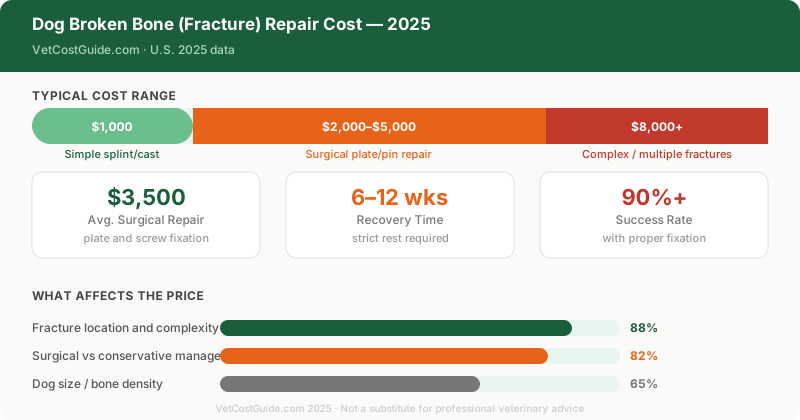
A dog with a broken leg is one of the more common orthopedic emergencies in veterinary medicine, and the cost to fix it spans a remarkably wide range: $500–$1,200 for a simple fracture managed with a cast or splint, up to $5,000 or more for a complex fracture requiring surgical plate and screw fixation at a specialty hospital. The type of fracture, its location, whether it’s open (bone protruding through skin) or closed, and whether it affects a joint all determine which approach is appropriate—and what you’ll pay. In some cases, amputation ($1,500–$3,000) is the most appropriate, fastest-healing, and most cost-effective solution, particularly for severely comminuted fractures in small dogs.
- Initial X-rays to diagnose a fracture cost $150–$350; additional views or CT imaging for complex fractures add $400–$800.
- Splints and casts for simple, stable fractures cost $500–$1,200 total, but require 4–6 bandage changes at $75–$150 each during the 6–8 week healing period.
- Surgical plate-and-screw fixation for complex fractures costs $2,000–$5,000 at a surgical specialist and delivers the most reliable long-term outcome for articular and unstable fractures.
- Amputation costs $1,500–$3,000 and is often the fastest, least complicated treatment path for severely comminuted fractures in small dogs—dogs adapt remarkably well to three legs.
Dog Broken Bone Surgery Cost Breakdown
| Type | Low | Average | High |
|---|---|---|---|
| Initial X-rays (2–4 views) | $150 | $250 | $350 |
| CT scan (complex fractures) | $400 | $600 | $800 |
| Splint or cast (simple fracture) | $500 | $850 | $1,200 |
| Bandage change (per visit) | $75 | $112 | $150 |
| Surgical plate and screw fixation | $2,000 | $3,500 | $5,000 |
| External skeletal fixator (ESF) | $1,500 | $2,750 | $4,000 |
| Intramedullary pin fixation | $1,200 | $2,000 | $3,000 |
| Amputation | $1,500 | $2,250 | $3,000 |
| Post-op X-rays + rechecks | $300 | $450 | $600 |
| Rehabilitation therapy | $800 | $1,150 | $1,500 |
What’s Included in the Price
Initial diagnosis begins with physical examination and radiographs. A dog that is hit by a car needs more than just leg X-rays—chest radiographs to check for pneumothorax (collapsed lung), abdominal assessment, and blood pressure evaluation are standard before anesthesia for any fracture repair. Stabilization with IV fluids, pain medications, and splinting for transport may add $200–$400 before definitive repair begins.
Splinting and casting is appropriate only for certain fracture types: incomplete (greenstick) fractures, certain radius/ulna fractures in young dogs with good bone-healing potential, and mid-shaft fractures in bones not subject to significant rotational stress. The initial application costs $300–$600. Bandage changes every 1–2 weeks during the 6–8 week healing period add $75–$150 per visit, meaning total cast management runs $500–$1,200 including rechecks.
Plate and screw fixation (internal fixation) is the gold standard for most long-bone fractures, articular fractures (involving a joint surface), and unstable fractures. A veterinary surgical specialist places a bone plate directly on the fracture site with cortical screws. This provides immediate rigid stability, allowing weight-bearing within days. The surgery requires specialized implants, general anesthesia with monitoring, and 1–3 days of hospitalization.
External skeletal fixators (ESF) use pins that pass through the skin and bone and connect to an external frame. These are useful for open fractures (where the skin is broken over the bone), highly contaminated wounds, or fractures that need periodic adjustment. ESF is technically demanding and requires weekly to biweekly frame adjustments during healing.
Amputation involves removal of the entire limb at the shoulder (forelimb) or hip (hindlimb). It sounds extreme but is appropriate—and often the veterinary surgeon’s top recommendation—for severely comminuted fractures (shattered into multiple pieces), open fractures with severe infection, and fractures involving the joint in ways that cannot be reconstructed. Dogs adapt to three legs (called “tripods”) remarkably quickly and typically return to full activity within 4–6 weeks. The psychological adjustment is the owner’s, not the dog’s.
What Affects the Cost
Open vs. closed fracture. A closed fracture (skin intact over the bone) is a surgical repair. An open fracture (bone visible through the skin, or skin broken near the fracture) is a surgical emergency—contaminated, at high risk for osteomyelitis (bone infection), and requiring immediate debridement, lavage, and often staged repair. Open fractures cost significantly more to treat ($500–$1,500 more) and carry worse prognoses than closed fractures.
Fracture location. Femur fractures (upper hind leg) almost always require surgical fixation—the powerful quadriceps muscles pull the fracture fragments apart and cannot be managed with external coaptation. Radius/ulna fractures in small breeds have notoriously poor healing with splints alone due to poor blood supply and small bone diameter; surgical repair is usually recommended. Rib fractures typically heal without intervention; vertebral fractures may require spinal surgery ($4,000–$12,000).
Dog size and breed. Small breeds (under 10 pounds) have thinner, more fragile bones that are technically challenging to plate. Toy breeds—Chihuahuas, Yorkshire Terriers, Pomeranians—commonly suffer radius fractures from jumping off furniture, and these fractures have higher complication rates than in medium to large breeds. Implant cost scales with dog size; large-breed plates are more expensive than small-breed plates.
Specialist vs. general practitioner. Many general practitioners can manage simple fractures competently. Complex articular fractures, fractures requiring ESF, and most femur repairs are best managed by board-certified veterinary surgeons (DACVS credentials). Specialist fees are 30–50% higher per hour, but complication rates are lower and outcomes more predictable—particularly for the fractures that are most technically demanding.
Rehabilitation therapy. Post-operative rehabilitation reduces healing time, prevents muscle atrophy, and improves long-term joint function. Underwater treadmill, therapeutic exercises, and manual therapy at $100–$200 per session over 6–12 sessions add $800–$1,500 to total cost but are associated with better 12-month outcomes.
- Attempting to splint a dog’s fracture at home before reaching the vet. Improper splinting can cut off blood flow to the limb, damage surrounding tissue, and worsen the fracture. Confine the dog, minimize movement, and transport carefully on a flat surface—do not attempt to immobilize the fracture yourself.
- Choosing the cheapest repair option without considering healing rates. Budget-based decisions that opt for splinting when the fracture type actually requires surgery frequently result in malunion (improper healing), delayed union (failure to heal), or implant failure—each requiring a second surgery that costs as much as doing it right the first time.
- Underestimating bandage change costs for splinted fractures. A splint that costs $400 to apply will require $600–$900 in bandage changes over the healing period. Failure to keep bandage appointments leads to pressure sores, bandage-related injuries, and delayed healing—a false economy.
Is Pet Insurance Worth It?
Fracture repair is one of the most clear-cut cases for pet insurance value. A $4,000 surgical repair with 80% reimbursement after a $250 deductible returns $3,000—likely more than several years of premiums for a young dog. Fractures from trauma (hit by car, falls, dog bites) are covered under accident policies, which are less expensive than comprehensive accident-and-illness policies and sufficient for orthopedic trauma.
Accident-only policies for dogs run $15–$30/month, making them a cost-effective option for owners primarily concerned about trauma events rather than illness. A young, healthy dog in a suburban household is more likely to be injured by a car or fall than to develop cancer—accident-only coverage addresses that specific risk.
High-risk situations to consider: dogs that run loose outdoors, dogs that regularly jump from heights, and households near busy roads. These increase the statistical likelihood of trauma and make the case for coverage stronger.
How to Save Money
Get a specialist opinion before committing to any repair approach. An initial consultation with a board-certified veterinary surgeon ($200–$400) provides the clearest diagnosis of fracture type and all appropriate repair options, including conservative management if it’s genuinely suitable. This consultation often saves money by preventing inappropriate conservative treatment that fails, requiring a second surgery.
Ask specifically about amputation as an option. Surgeons will recommend it when indicated, but owners sometimes resist without asking why. For many fracture types in small dogs or dogs with contaminated open fractures, amputation is the fastest, most reliable, and most cost-effective path to a comfortable, mobile dog—often $1,000–$2,500 less than complex reconstruction.
Compare veterinary school teaching hospitals. University orthopedic services perform plate-and-screw fixation, ESF, and complex joint reconstruction at 20–40% below private specialist prices. Wait times may be 24–72 hours for non-emergency cases, but the clinical quality is equivalent.
Budget for the full treatment course, not just surgery. Include post-op X-rays, bandage changes or hardware removal, rechecks, and rehabilitation when comparing total cost across treatment options. A cheap surgery with expensive ongoing management may cost more than a comprehensive one-time specialist repair.
Frequently Asked Questions
How long does a broken bone take to heal in a dog? Simple fractures in young, healthy dogs heal in 6–8 weeks with appropriate fixation. Complex fractures, open fractures, and fractures in older dogs may take 10–16 weeks or longer. Bone healing is confirmed by follow-up radiographs showing callus formation across the fracture line—not by the dog’s willingness to use the leg.
Will my dog be in pain with a broken bone? Yes, fractures are acutely painful. Emergency pain management with opioids and anti-inflammatory medications is standard practice from the initial presentation. Post-surgical pain is managed with multimodal protocols including NSAIDs, gabapentin, and often an opioid for the first 3–5 days. Adequate pain control is not negotiable and improves healing outcomes.
What is the most common cause of broken bones in dogs? Hit by car (HBC) is the leading cause of long-bone fractures in dogs, accounting for 50–70% of cases in most emergency hospital data. Falls from heights are the leading cause in toy breeds. Dog bites, pathological fractures from bone tumors, and accidental trauma (caught in fencing, stair falls) account for the remainder.
Can a broken bone heal on its own without treatment? In rare cases—certain rib fractures, incomplete (greenstick) fractures in very young dogs—conservative rest-based management may be appropriate. However, long-bone fractures in dogs do not reliably heal without intervention. Untreated, they become infected, develop malunion or nonunion, and cause chronic pain and disability. All long-bone fractures should be evaluated by a veterinarian within 24 hours of injury.