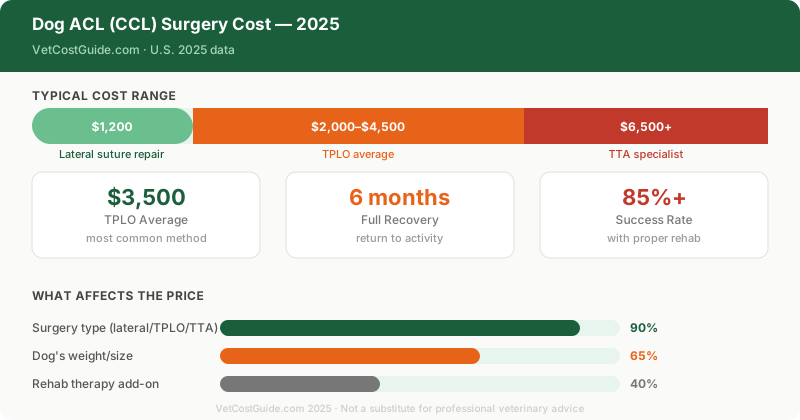
Dogs don’t technically have an ACL — they have a cranial cruciate ligament (CCL) — but the injury and the heartbreak feel exactly the same. When that ligament tears, your vet will discuss three surgical repair options ranging from $1,200 to $7,000, and the price difference reflects genuinely different procedures with different long-term outcomes. This guide breaks down all three methods so you understand exactly what you’re comparing.
- Lateral suture repair (extracapsular) costs $1,200–$2,500 and is best for dogs under 30 lbs.
- TTA (Tibial Tuberosity Advancement) costs $2,800–$5,500 and is comparable to TPLO in most dogs.
- TPLO (Tibial Plateau Leveling Osteotomy) costs $3,500–$7,000 and is the most evidence-backed option for large, active dogs.
- All three methods require anesthesia, implants or suture materials, and post-op rehabilitation.
- A board-certified surgeon performing any of these three methods outperforms a generalist performing the “cheaper” option.
What Does Dog ACL Surgery Cost?
The price range across all three repair methods in 2025 reflects both technique complexity and the expertise required to perform them correctly.
| Repair Method | Low | Average | High |
|---|---|---|---|
| Lateral Suture (Extracapsular) | $1,200 | $1,800 | $2,500 |
| TTA (Tibial Tuberosity Advancement) | $2,800 | $4,000 | $5,500 |
| TPLO (Tibial Plateau Leveling) | $3,500 | $4,800 | $7,000 |
| Pre-op diagnostics (X-rays + bloodwork) | $230 | $450 | $820 |
| Post-op physical rehabilitation | $500 | $1,200 | $2,000 |
| Revision surgery (complication) | $1,500 | $3,000 | $5,000 |
What’s Included in the Price?
All three repair methods include anesthesia, the surgeon’s fee, intraoperative monitoring, and materials — but the materials differ substantially. Lateral suture repair uses a monofilament nylon or braided line threaded around the joint to replicate the stabilizing function of the torn ligament. The materials are inexpensive; the cost reflects the surgical skill and post-op monitoring.
TTA and TPLO are bone-cutting procedures that change the geometry of the stifle joint so the ruptured ligament becomes biomechanically irrelevant. TTA involves advancing the tibial tuberosity and securing it with a titanium cage and bone plate. TPLO cuts and rotates the tibial plateau and plates it in the new position. Both require specialty implants ($300–$700), intraoperative fluoroscopy or X-ray for confirmation, and the skills of a surgeon familiar with veterinary orthopedics.
Regardless of which surgery your dog has, you’ll also pay for pre-op bloodwork ($80–$220) and X-rays ($150–$400) to stage the procedure. Post-op rechecks at 6 and 12 weeks typically include radiographs to confirm bone healing and implant stability.
What Affects the Cost?
Dog weight and size. Lateral suture repair has a known failure rate in dogs over 30–40 pounds because the suture material fatigues under repeated loading. This is the biggest clinical factor driving surgeons to recommend TPLO or TTA for larger dogs — not just cost.
Surgeon specialization. A board-certified DACVS surgeon at a specialty orthopedic practice costs more than a general practitioner performing the same technique. For TPLO and TTA, the precision of bone cuts matters enormously for outcomes; specialist fees are justified.
Geographic location. Expect to pay 20–35% more in major coastal cities than in the Midwest or South. A $4,500 TPLO in Dallas may cost $6,200 in San Jose.
Concurrent joint damage. A torn meniscus discovered intraoperatively adds $300–$600 to the bill. Moderate to severe arthritis at the time of surgery may require additional treatment.
Facility overhead. A 24-hour specialty emergency hospital with advanced monitoring equipment charges more than a daytime orthopedic practice. Both can deliver excellent outcomes.
- Choosing the cheap option for the wrong dog. A $1,500 lateral suture on a 70-pound dog may fail within 6–18 months, leaving you with a revision surgery bill that exceeds what TPLO would have cost initially.
- Quotes that exclude anesthesia. Some practices advertise surgery prices that don’t include anesthesia, monitoring, or post-op medications. Always ask for a complete, itemized estimate.
- Skipping the orthopedic referral. Your primary vet may perform lateral suture repairs, but TPLO and TTA should be performed by surgeons with documented experience in these techniques. Ask how many procedures per year the surgeon performs.
Is Pet Insurance Worth It for This?
CCL repair is one of the most common reasons pet owners file major claims, and most comprehensive pet insurance policies cover it under orthopedic or illness benefits. With a $500 deductible and 80% reimbursement on a $5,000 TPLO, you’d receive $3,600 back. For large-breed dogs — Labrador Retrievers, Golden Retrievers, German Shepherds, Rottweilers, Newfoundlands — who have dramatically elevated CCL injury rates, comprehensive coverage is cost-effective over a 10-year span.
One important nuance: many insurers treat CCL tears as a bilateral condition. Once the first leg is torn and claimed, the second leg may be excluded as a related condition by some insurers. Read the fine print on “bilateral exclusion” clauses before buying a policy and understand your specific plan’s stance before the second leg shows symptoms.
How to Save Money
Compare surgical approaches honestly with your vet. For a 20-pound dog, lateral suture repair may be fully appropriate and saves $1,500–$3,000. Don’t pay for TPLO complexity you don’t need.
University teaching hospital referral. Resident surgeons supervised by DACVS specialists perform TPLO and TTA at 30–50% reduced cost. Ask your primary vet for a referral to the nearest veterinary school.
Ask about staged bilateral discounts. If your dog is likely to need the second leg treated, ask whether doing both at once (or within 60 days) qualifies for a package pricing reduction.
Use CareCredit or Scratchpay. Both programs offer 0% APR financing for 6–18 months, making a $4,000–$5,000 surgery manageable at $250–$700 per month without interest.
Invest in rehabilitation. It seems counterintuitive, but $800–$1,500 spent on formal physical rehabilitation reduces re-injury risk and decreases the likelihood of expensive complications like muscle atrophy, compensatory injuries in the opposite leg, and implant stress.
Frequently Asked Questions
How do I know which surgery my dog needs? Your primary vet will refer you to an orthopedic surgeon who will assess your dog’s weight, activity level, the degree of joint instability, the presence of arthritis, and your budget. Lateral suture is appropriate for small, sedentary dogs; TPLO and TTA are better for medium-to-large or high-activity dogs.
Can a CCL tear heal without surgery? In small dogs (under 15–20 lbs) with partial tears, strict rest and physical therapy sometimes produces acceptable functional outcomes. In dogs over 25 pounds with complete tears, non-surgical management reliably fails — leading to progressive arthritis and permanent lameness. Surgery is the medical standard of care for most dogs.
How long until my dog can walk normally after surgery? Most dogs begin bearing weight within 1–2 weeks after TPLO or TTA, with full functional recovery by 4–6 months. Lateral suture recovery is faster initially but provides less long-term stability in large dogs.
What is the success rate for dog CCL surgery? All three methods have high success rates when performed correctly on appropriate candidates. TPLO shows 90–95% excellent to good outcomes in published studies. Lateral suture in small dogs shows similar results. The key predictor of outcome is surgeon experience, not technique.