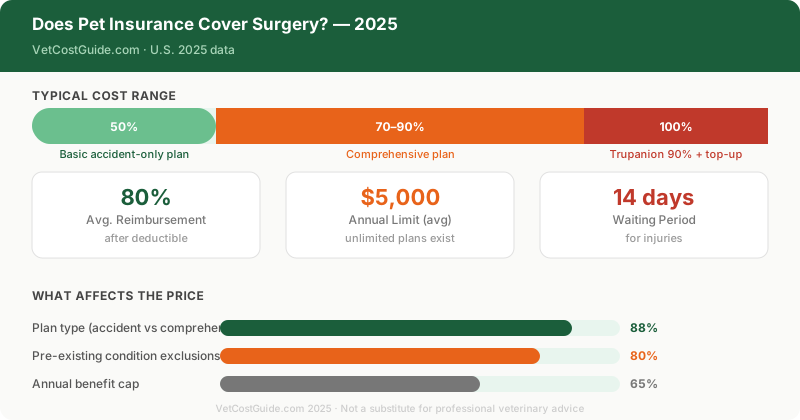
A TPLO knee surgery for a dog costs $4,500 to $7,000. Bloat surgery can run $3,000 to $7,500 and needs to happen within hours. A tumor removal with biopsy averages $1,500 to $4,000. These are the bills that make or break a family’s finances—and whether your pet insurance actually covers them depends entirely on the type of plan you have and when you enrolled. Most comprehensive plans do cover surgery, but the coverage gap between a comprehensive plan and an accident-only plan is enormous.
- Comprehensive accident and illness plans cover most surgeries at 70–90% reimbursement after your deductible—including orthopedic, emergency, and cancer surgery.
- Accident-only plans cover emergency trauma surgery (car accidents, lacerations) but exclude any surgery for illness, cancer, or internal disease.
- Elective procedures like routine spay/neuter are typically not covered by standard plans—you need a wellness add-on for those.
- A $5,000 TPLO surgery with an 80% plan and $250 deductible results in $3,800 reimbursement, leaving you $1,200 out-of-pocket.
Surgery Coverage by Plan Type
The table below shows which procedures are covered under each common plan structure. Coverage assumes the condition was not pre-existing at enrollment.
| Surgery Type | Comprehensive Plan | Accident-Only Plan | Wellness Add-On |
|---|---|---|---|
| TPLO / CCL repair | Covered | Not covered | Not covered |
| Hip replacement | Covered | Not covered | Not covered |
| Bloat/GDV surgery | Covered | Covered (trauma) | Not covered |
| Foreign body removal | Covered | Covered (if ingested) | Not covered |
| Tumor removal | Covered | Not covered | Not covered |
| Eye surgery (cherry eye, entropion) | Covered | Not covered | Not covered |
| Emergency trauma surgery | Covered | Covered | Not covered |
| Routine spay/neuter | Not covered (standard) | Not covered | Covered by some |
| Dental surgery (illness) | Covered by some | Not covered | Covered by some |
How Comprehensive Surgery Coverage Works
When your pet needs surgery under a comprehensive plan, the reimbursement calculation follows a simple sequence. First, your vet submits or you submit the itemized invoice. The insurer applies your annual deductible (if not yet met) to the total. Then your reimbursement rate—70%, 80%, or 90%—applies to the remaining balance.
Example: TPLO surgery Total bill: $5,000. Annual deductible remaining: $250. Reimbursement rate: 80%. After deductible: $4,750. 80% of $4,750 = $3,800 reimbursed. Your cost: $1,200.
Example: Bloat/GDV surgery Total bill: $6,500. Deductible already met earlier in year: $0. Reimbursement: 80%. 80% of $6,500 = $5,200 reimbursed. Your cost: $1,300.
Pre-authorization is not typically required before emergency surgery. For planned orthopedic or elective surgeries, some insurers offer pre-authorization as an option—submit records and get written confirmation of coverage before the procedure. This eliminates claim denial surprises.
What Affects Whether Surgery Is Covered
Plan type is the primary factor. Accident-only plans are significantly cheaper ($15–35/month vs. $40–100/month for comprehensive) but the coverage gap is enormous for illness-related surgery. Bloat, cancer, orthopedic conditions, and internal medicine surgeries all fall under the illness category.
Pre-existing condition status is the most common reason surgical claims are denied. If your dog was limping before enrollment, the insurer may deny a cruciate repair claim on the grounds that the condition pre-existed the policy. This is why enrolling before any symptoms or diagnoses is critical.
Bilateral exclusions affect orthopedic surgery particularly. If one knee, hip, or eye was treated before enrollment, many insurers will exclude both sides. A TPLO on the “healthy” knee may be denied under this rule.
Waiting periods matter for planned surgeries. Most comprehensive plans impose a 14-day illness waiting period and a 6-month orthopedic waiting period. If your dog tears their cruciate ligament within the first 6 months of coverage, the claim will be denied at most insurers. Embrace and ASPCA both enforce 6-month orthopedic waiting periods; some plans extend this to 12 months.
| Surgery | Avg Cost | 80% Plan Reimbursement | Your Cost After Deductible ($250) |
|---|---|---|---|
| TPLO (cruciate repair) | $5,000–$7,000 | $3,800–$5,400 | $1,000–$1,800 |
| Hip replacement | $3,500–$7,000 | $2,600–$5,400 | $900–$1,800 |
| Bloat/GDV | $3,000–$7,500 | $2,200–$5,800 | $800–$1,900 |
| Tumor removal | $1,500–$4,000 | $1,000–$3,000 | $500–$1,200 |
| Foreign body removal | $2,000–$5,000 | $1,400–$3,800 | $600–$1,400 |
| Eye surgery | $1,000–$3,500 | $600–$2,600 | $400–$1,100 |
- Buying an accident-only plan thinking it covers surgery, without realizing illness-related surgery (cancer, orthopedics, bloat) is excluded.
- Waiting until a breed-typical condition shows symptoms before enrolling—orthopedic waiting periods start at enrollment, not at symptom onset.
- Assuming pre-authorization is required in emergencies—most insurers explicitly allow emergency treatment without pre-approval.
- Not checking whether your annual limit is sufficient for high-cost surgeries; a $5,000 annual cap disappears quickly if your dog also had other claims that year.
Which Plans Handle Surgical Coverage Best
For surgical coverage specifically, the strongest-performing plans in 2025 are:
Trupanion — 90% reimbursement, unlimited annual payout, direct payment to the vet at over 9,000 participating hospitals. No payout cap means a $12,000 multi-stage cancer surgery is fully eligible. Per-incident deductible means one deductible per condition, not per year.
Embrace — 70–90% choice, $5,000 to unlimited annual limits, covers orthopedic surgery after the 6-month waiting period. Offers written pre-authorization for planned procedures, which is valuable for scheduled orthopedic surgeries.
ASPCA — Covers bilateral conditions more liberally than some competitors. Orthopedic coverage after 14 days (vs. 6 months at most), which is the most favorable waiting period in the industry for accident-related orthopedic injuries.
Healthy Paws — Unlimited annual and lifetime payouts, strong track record on surgical claims, and faster-than-average reimbursement (average 2 days for approved claims).
FAQ
Do I need pre-authorization for emergency surgery? No. All major insurers allow emergency surgery without prior approval. Submit the claim with itemized invoices and vet records after the procedure.
Are anesthesia and hospitalization costs covered as part of surgery? Yes. Comprehensive plans cover the full surgical episode—anesthesia, facility fees, pre-surgical bloodwork, and post-operative hospitalization—as part of the same claim.
Does pet insurance cover surgery for cancer? Yes, if the cancer was not diagnosed before enrollment. Tumor removal, chemotherapy, and radiation are covered under comprehensive plans. Cancer is one of the most expensive conditions in veterinary medicine, making it one of the strongest arguments for comprehensive coverage.
What if the surgery costs more than my annual limit? You’re responsible for costs above your annual limit. A $10,000 annual limit is usually sufficient, but dogs with complex orthopedic conditions or cancer can exceed this in a single year. Consider unlimited annual limit plans if your breed has elevated surgical risk.