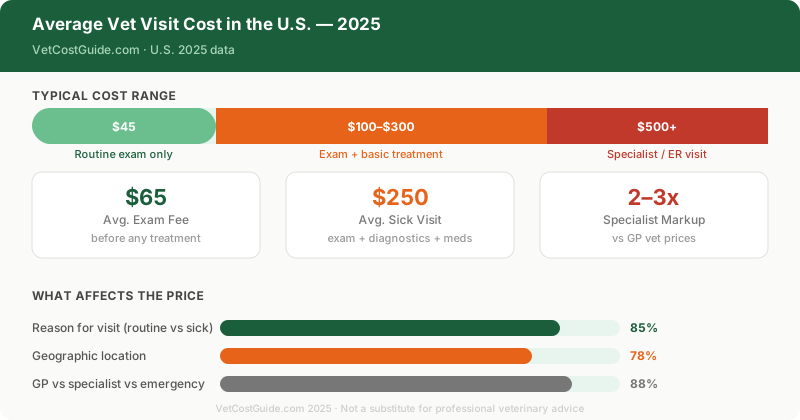
The national average vet exam fee of $65 tells you almost nothing about what you’ll actually spend at a vet visit. The exam fee is just the entry point—a single wellness appointment for a dog typically runs $150 to $300 once you add annual vaccines, heartworm testing, flea prevention, and basic diagnostics. A sick visit for a dog with vomiting and lethargy can run $250 to $500 before any significant diagnostic work, and $500 to $1,200 if bloodwork, x-rays, and medications are needed. Understanding the full cost structure of a vet visit—not just the exam fee—is what allows you to budget accurately and avoid financial surprises.
- The average exam fee nationally is $55–$85; specialist and emergency exam fees run $150–$350 and $200–$500 respectively.
- A routine annual wellness visit (exam + core vaccines + heartworm test + flea prevention) costs $150–$300 for dogs; $130–$250 for cats.
- Diagnostic add-ons—bloodwork, urinalysis, x-rays—each add $80–$400 per item and are the most significant cost variable on sick visits.
- Veterinary costs in New York City, Los Angeles, and San Francisco run 40–60% above the national average; rural South and Midwest run 20–30% below.
Breakdown of Common Vet Visit Costs (2025 National Averages)
| Service | Low End | High End | National Average |
|---|---|---|---|
| Office exam fee | $45 | $85 | $65 |
| Specialist exam fee | $150 | $350 | $225 |
| Emergency exam fee (no treatment) | $200 | $500 | $300 |
| Rabies vaccine | $20 | $35 | $28 |
| DHPP vaccine (dogs) | $22 | $42 | $30 |
| FVRCP vaccine (cats) | $20 | $38 | $28 |
| Bordetella (dogs) | $18 | $35 | $25 |
| Heartworm test | $45 | $75 | $58 |
| Flea/tick prevention (3 months) | $40 | $80 | $55 |
| CBC + Chemistry bloodwork | $80 | $200 | $130 |
| Urinalysis | $45 | $80 | $58 |
| X-ray (1–2 views) | $150 | $400 | $250 |
| Fecal exam | $25 | $55 | $38 |
| Microchipping | $35 | $55 | $45 |
| Dental cleaning (anesthesia incl.) | $400 | $1,000 | $650 |
Wellness Visit vs. Sick Visit: Real Total Costs
Annual wellness visit — Dog (no issues found): Exam ($65) + DHPP ($30) + rabies ($28) + bordetella ($25) + heartworm test ($58) + fecal ($38) + flea prevention 3-month supply ($55) = $299 typical total
Some vets also recommend a geriatric panel for dogs over age 7, adding $130–200. Senior dogs routinely cost $400–500 for their annual wellness visit.
Annual wellness visit — Cat (indoor, no issues): Exam ($65) + FVRCP ($28) + rabies ($28) + fecal ($38) = $159 typical total
Indoor cats with no flea exposure and current vaccines may be closer to $100–120 once you factor in that some boosters are given every 3 years rather than annually.
Sick visit — Dog with vomiting and lethargy: Exam ($65) + CBC/Chemistry ($130) + x-rays ($250) + anti-nausea injection ($30) + subcutaneous fluids ($45) + take-home medications ($60) = $580 typical total
If findings on bloodwork or x-rays indicate more serious disease (pancreatitis requiring hospitalization, foreign body requiring surgery, kidney failure), the total can climb to $1,500–$5,000+ depending on the diagnosis.
| Visit Type | Typical Range | What Drives the Range |
|---|---|---|
| Annual wellness (dog, young) | $150–$300 | Which vaccines are due this year |
| Annual wellness (dog, senior 7+) | $300–$500 | Add senior bloodwork panel |
| Annual wellness (cat, indoor) | $100–$200 | Vaccine schedule, age |
| Sick visit (minor, 1 diagnostic) | $150–$350 | Type of diagnostics needed |
| Sick visit (moderate, 2–3 diagnostics) | $300–$650 | Bloodwork + imaging combination |
| Sick visit (hospitalization required) | $800–$2,500 | Length of stay, IV fluids, monitoring |
| ER visit (after hours) | $300–$800 | Emergency surcharge + diagnostics |
| Specialist consultation | $250–$600 | Species, specialty type |
What Affects Vet Costs Most
Geographic location is the most consistent cost variable across all vet services. The same annual wellness visit that costs $180 in rural Mississippi costs $320 in Chicago and $420 in Manhattan. This isn’t arbitrary—it reflects real differences in commercial rent, staff wages, and regional market pricing.
Geographic cost index approximate multipliers:
- San Francisco, NYC, LA, Seattle: 1.4–1.6× national average
- Chicago, Boston, Denver, DC: 1.2–1.4× national average
- National average benchmark: 1.0×
- Rural Midwest, rural South: 0.7–0.8× national average
Practice type also affects cost substantially. Corporate chains like Banfield (PetSmart) and VCA have standardized pricing that varies less by region but is generally competitive on wellness care. Independent boutique practices in urban areas typically charge the most. Emergency and specialty hospitals apply surcharges—emergency fees of $150–$250 on top of standard services are standard.
Pet size and species affects medication dosing, anesthesia cost, and procedural complexity. A dental cleaning on a 90-pound dog requires more anesthesia and takes longer than on a 10-pound cat. Medications are often dosed by weight, making large dogs significantly more expensive to treat than small dogs.
- Budgeting only the exam fee and being surprised by the full invoice—always ask for a cost estimate before any diagnostic or treatment is performed.
- Skipping annual wellness visits to save money—early detection of developing conditions in bloodwork or physical exam consistently reduces total lifetime veterinary costs.
- Not comparison shopping for routine services—calling three local clinics for a vaccine-only appointment price takes 10 minutes and can save $40–$80.
- Assuming the same service costs the same at any clinic—pricing variation of 50–100% between practices in the same city is common and normal.
How to Budget for Vet Costs
The most practical budgeting framework: plan for one annual wellness visit per pet plus one unexpected sick visit per year. For a single young dog, this means budgeting approximately $400–$600 per year. For a senior dog, budget $600–$1,000. Multi-pet households should plan $250–$400 per additional pet.
To reduce costs without reducing care quality:
Ask for itemized estimates. Before any appointment beyond a basic exam, ask what will be included and what each item costs. Declining non-urgent add-ons at a wellness visit is completely reasonable.
Use low-cost clinics for preventive care. Core vaccines and heartworm testing at a Humane Society or ASPCA-affiliated clinic cost 40–60% less than at a private practice. Reserve your regular vet relationship for sick visits and complex care.
Consider pet insurance. For pets likely to generate large sick-visit costs—older dogs, brachycephalic breeds, high-energy dogs prone to trauma—insurance at $40–$80/month often reduces total annual spend versus paying all costs out-of-pocket.
FAQ
Why did my vet bill look so different from these averages? Geographic variation, practice type, and the specific services provided all create wide ranges. If your bill seems high, ask for an itemized breakdown and compare individual line items to local market rates.
Should I go to an emergency hospital for after-hours illness? For true emergencies—difficulty breathing, suspected poisoning, severe trauma, inability to urinate—yes, immediately. For non-urgent issues that can wait until regular hours, calling your vet’s emergency line or an urgent care veterinary clinic first can save $150–$300 in emergency surcharges.
Is it normal for my vet to recommend services at every visit? Your vet will make recommendations based on your pet’s specific needs. You are always entitled to ask which recommendations are essential now vs. elective or deferrable. A good vet will help you prioritize.
Do vets charge differently for dogs vs. cats for the same service? Sometimes. Dog vaccines and large-dog procedures typically cost more than cat equivalents due to higher drug volumes and procedure time. The exam fee is usually the same regardless of species.