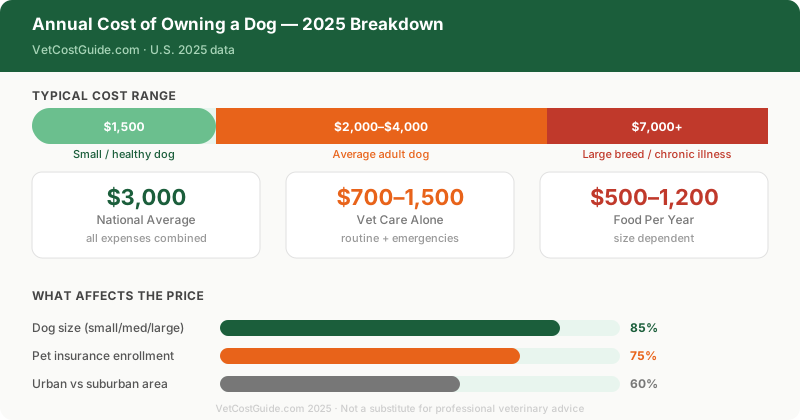
Before you bring a dog home, you need a realistic number. Not the best-case scenario where nothing goes wrong and you never board your dog — the actual, honest annual cost that reflects what American dog owners really spend. In 2025, that number ranges from $1,500–$2,500 per year for small dogs to $3,000–$6,000+ for giant breeds. Size drives cost in almost every category: food portions, medication doses, boarding fees, and surgical costs all scale upward with body weight. Here’s what the real math looks like, broken down by size.
- Small dogs (under 25 lbs) cost $1,500–$2,500/year on average — the most budget-friendly option in most expense categories.
- Large dogs (50–90 lbs) average $2,500–$4,500/year, primarily due to higher food, boarding, and medication costs.
- Giant breeds (90+ lbs) cost $3,000–$6,000/year and have a shorter average lifespan, meaning the total lifetime cost is concentrated into fewer years.
- Boarding or doggy daycare is often the most underestimated expense — $500–$3,000/year for owners who travel or work long hours.
Cost Breakdown by Dog Size
| Expense Category | Small Dog | Medium Dog | Large Dog | Giant Breed |
|---|---|---|---|---|
| Food (annual) | $500 | $800 | $1,200 | $1,800 |
| Vet Care (annual, healthy dog) | $700 | $900 | $1,100 | $1,500 |
| Grooming (annual) | $0–$300 | $200–$500 | $200–$600 | $200–$800 |
| Boarding/Daycare (annual) | $500 | $1,000 | $1,500 | $2,000 |
| Supplies/Toys/Bed (annual) | $200 | $300 | $400 | $500 |
| Training (year 1) | $0–$300 | $0–$500 | $0–$500 | $0–$500 |
| Insurance (optional, annual) | $300 | $450 | $600 | $800 |
| Total (without insurance) | $1,500 | $2,500 | $3,500 | $5,000 |
These totals assume a healthy adult dog, one week of boarding per year, no professional training after the first year, and annual wellness vet care with no major illness. Real-world costs run higher for dogs with health issues, frequent boarding, or professional grooming requirements.
What’s Included
Food. Annual food costs vary enormously based on your dog’s size and the food quality you choose. A 10-lb small dog eating a mid-quality dry kibble costs $500–$700/year; a 100-lb Great Dane costs $1,400–$1,800/year for the same quality diet. Raw, fresh-food, or prescription diets significantly increase these figures — a large dog on a fresh-food subscription (Farmer’s Dog, Ollie) can cost $3,000–$4,000/year in food alone.
Veterinary care. A healthy adult dog’s annual vet costs include a wellness exam ($50–$90), core vaccines ($60–$100), heartworm and flea/tick prevention ($150–$350), and the 4Dx test ($45–$75). Add dental cleaning every 1–3 years ($300–$900 depending on size and extractions) and you have a realistic range of $700–$1,500/year for a healthy dog. This category doesn’t include illness or injury — see below.
Grooming. Low-maintenance short-coated breeds (Labrador, Beagle, Boxer) need occasional nail trims and baths — many owners handle this at home for near zero cost. High-maintenance breeds (Poodles, Doodles, Shih Tzus, Schnauzers) need professional grooming every 6–8 weeks at $50–$130 per appointment, totaling $400–$800/year. This is one of the most significant variable costs between breeds.
Boarding and daycare. If you work full-time or travel, boarding and daycare are substantial line items. Pet boarding runs $35–$75/night for small dogs; $50–$100/night for large breeds. Two weeks of boarding per year costs $500–$1,400. Daily doggy daycare ($20–$45/day, 2 days per week) adds $2,000–$4,700/year — often the single largest expense for working owners.
Supplies and equipment. First year costs are higher (collar, leash, crate, bed, food bowls — $300–$600 setup). Annual replacement and restocking runs $200–$500, covering toys, treats, replacement bedding, leashes, and grooming tools.
Training. Year one training is strongly recommended — group puppy classes run $150–$300; private obedience training $500–$1,500. Well-trained dogs cost less in behavioral damage, vet care, and replacement household items over their lifetime. After year one, most owners don’t pursue ongoing formal training.
What Affects the Cost
1. Breed-specific health conditions. Certain breeds carry dramatically higher lifetime medical costs. English Bulldogs, French Bulldogs, and Pugs face brachycephalic airway syndrome surgery ($2,000–$5,000). German Shepherds and Labradors have high hip dysplasia rates (hip replacement $3,500–$7,000 per hip). Cavalier King Charles Spaniels have high rates of mitral valve disease requiring cardiac medication ($100–$300/month). Research your breed’s common health issues before purchasing.
2. Pet insurance. A comprehensive illness and accident policy adds $300–$800/year to annual costs but can save $5,000–$30,000 if a major illness or accident occurs. For large and giant breeds with known health predispositions, insurance ROI is particularly strong.
3. Urban vs. rural living. Urban dog ownership adds costs unavoidably: no yard means more daily walks (time or dog walker fees), leash requirements, and often mandatory daycare for working owners. Dog walkers in major cities charge $20–$35 per 30-minute walk — two walks a day, five days a week comes to $10,000–$18,000/year.
4. Age. Puppy first year is highest (spay/neuter $250–$500, initial vaccine series, supplies, training). Adult years are most stable. Senior dogs (age 7–8+ for large breeds, 10+ for small) see rising veterinary costs for age-related conditions.
5. Diet choices. The range between budget dry kibble (~$1/day for small dogs) and premium fresh food ($8–$15/day for large dogs) is enormous. Food quality matters for long-term health but the optimal choice isn’t always the most expensive.
- Underestimating emergency vet costs. A single emergency visit — fractured leg, foreign body ingestion, acute illness — averages $800–$2,500. Without insurance or an emergency fund, this can derail a household budget. Building a $2,000–$3,000 pet emergency fund is the financial equivalent of insurance for those who choose not to purchase a policy.
- Giant breed food and medication scaling. Giant breeds don’t just cost more to feed — they cost more for everything dose-dependent: flea prevention, heartworm prevention, pain medication, and anesthesia all scale with weight. A 120-lb dog’s monthly prevention costs 3–4x what a 20-lb dog pays.
- First-year puppy costs. New owners routinely underestimate Year 1: spay/neuter, initial vaccine series, crate, bedding, training, and the miscellaneous costs of puppyhood (replacement chewed items) often push Year 1 costs 50–100% higher than subsequent years.
Is Pet Insurance Worth It?
Pet insurance makes the most financial sense for large and giant breeds, brachycephalic breeds, and purebred dogs with known health predispositions. These dogs face higher-probability, high-cost medical events that insurance is designed to absorb.
For a healthy small mixed-breed dog in a low-risk environment, the math is tighter — particularly if a robust emergency fund exists as an alternative. Over a 15-year lifespan, a small dog owner paying $300/year in premiums spends $4,500 — roughly the cost of one serious illness or injury. If the dog remains healthy, the premiums are the “loss.”
Policies from Trupanion, Embrace, and Figo consistently receive high marks for large-breed illness coverage. For giant breeds in particular, policies should be purchased as young puppies before orthopedic conditions become pre-existing.
How to Save Money
Buy food in bulk from warehouse clubs. Sam’s Club and Costco carry quality dry kibble brands at 20–30% below pet store prices. Rotate your selection to buy whatever is on sale in your quality tier.
Learn basic grooming. A $50–$80 investment in a quality dog clipper and 2–3 YouTube tutorial sessions can eliminate professional grooming costs entirely for many breeds — saving $400–$800/year.
Choose a low-maintenance breed. If cost matters, factor grooming and health predispositions into breed selection. A Beagle or Mutt requires far less grooming and typically fewer breed-specific health costs than a Poodle mix or purebred French Bulldog.
Use veterinary school clinics. Major universities with veterinary schools (Cornell, UC Davis, Michigan State, Colorado State) offer wellness care and specialist services at significantly reduced rates compared to private practices.
Get quotes for boarding alternatives. Rover.com and Wag offer in-home pet sitting that’s often 20–40% cheaper than kennels — and many dogs are less stressed staying in a home environment.
Frequently Asked Questions
What’s the cheapest dog to own annually? Small, low-maintenance short-coated mixed breeds (shelter mutts around 15–25 lbs) have the lowest annual costs — typically $1,200–$1,800/year. They avoid breed-specific health costs, eat less food, and require no professional grooming. Avoid the false economy of choosing a dog based on purchase price alone — a free mixed breed from a shelter has lower lifetime costs than many $3,000 purebreds.
Do large dogs really cost that much more than small dogs? Yes, materially so. Food alone for a large dog costs 2–3x more annually. Add boarding ($50–$100/night vs $35–$50/night), larger doses of all medications, and higher surgical costs due to anesthesia weight-dosing, and large-dog ownership realistically costs $800–$1,500 more per year than small-dog ownership across all categories.
Does dog ownership get cheaper as dogs age? Not usually. Costs are highest in Year 1 (setup and puppy care), relatively stable in adult years, and rise again in senior years as veterinary costs for age-related conditions increase. Senior large-breed dogs often incur $2,000–$4,000/year in health-related costs alone.
Is it worth getting a dog walker vs. doggy daycare? It depends on your dog’s social needs and your schedule. Dog walkers ($20–$35/30-min walk) provide essential exercise and bathroom breaks for dogs home alone more than 8 hours. Daycare ($25–$45/day) is better for high-energy, social dogs who need structured activity. Both cost roughly $500–$1,200/month at full-time usage — factoring this in before getting a dog is essential for working owners.